Switch Stacking Technology
What is Switch Stacking
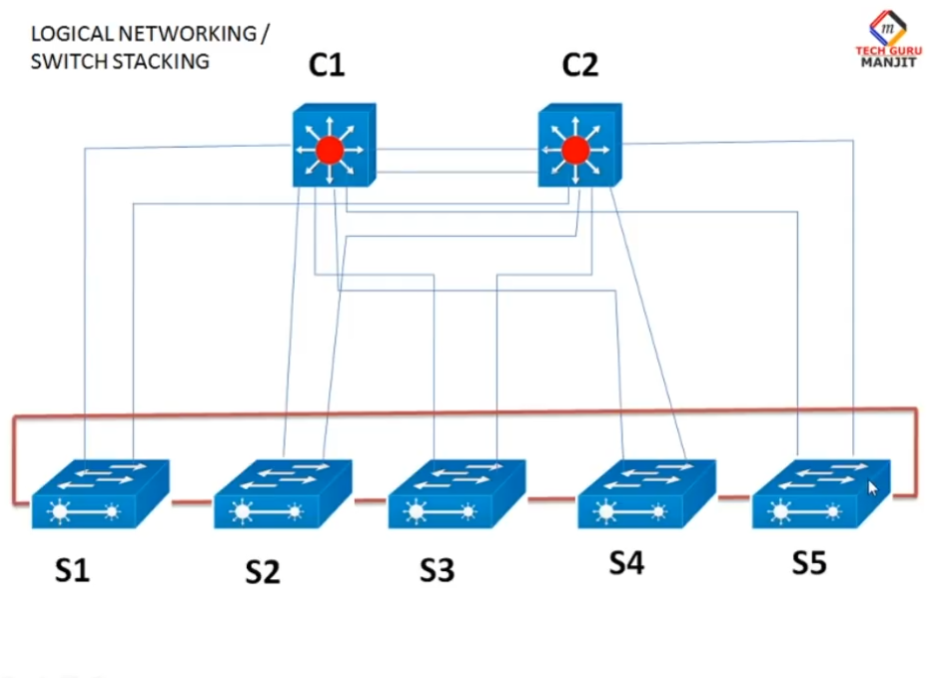
Switch stacking is a networking technology that allows multiple physical network switches to be interconnected and operate as a single logical switch. From the perspective of network administrators and connected devices, a stack of switches behaves like one large switch with a single management IP address and one unified configuration. This simplifies network management because all stacked switches can be controlled, monitored, and configured from one interface instead of managing each switch separately.
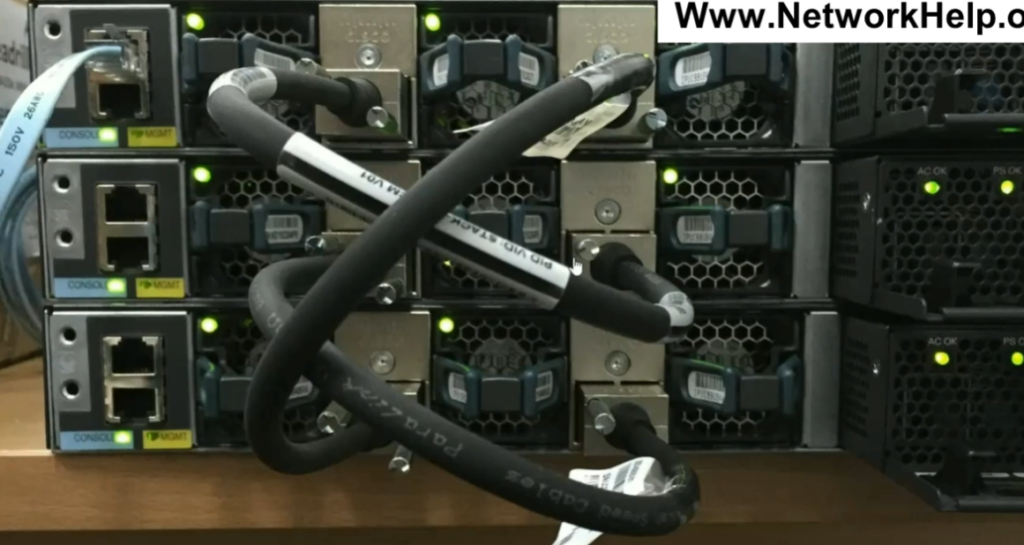
In switch stacking, the switches are connected using special stacking cables or dedicated stack ports that provide very high-speed communication between the devices. One switch in the stack is elected as the master (or primary) switch, which is responsible for managing the entire stack, handling configuration files, and controlling data forwarding decisions. The remaining switches act as member switches and follow the master’s instructions.
A key advantage of switch stacking is high availability and redundancy. If the master switch fails due to hardware or power issues, another switch in the stack automatically takes over as the new master without disrupting network operations for long. This failover mechanism ensures continuous network service and reduces downtime, which is especially important in business and enterprise environments.
Switch stacking also improves scalability and performance. When an organization needs more network ports, additional switches can simply be added to the existing stack instead of deploying and managing a completely new device. Because stacking links usually have much higher bandwidth than normal Ethernet links, traffic between switches in the stack flows quickly and efficiently, reducing congestion and improving overall network performance.
Overall, switch stacking provides a cost-effective and efficient way to build a larger, more reliable network using multiple smaller switches. It combines simplified management, better fault tolerance, and easy expansion, making it ideal for office networks, campus environments, and enterprise access-layer deployments where reliability and growth are important.
Switch Stacking Benefits
Switch stacking provides several important benefits that make it a popular choice in enterprise and campus networks. One of the main advantages is simplified management. When multiple switches are stacked, they operate as a single logical switch with one IP address and one configuration file. This allows network administrators to configure, monitor, and troubleshoot the entire stack from a single interface instead of managing each switch separately, saving time and reducing complexity.
Another major benefit of switch stacking is high availability and redundancy. If one switch in the stack fails due to hardware or power issues, another switch automatically takes over as the master. Network connectivity for users and devices continues with minimal interruption. This built-in failover mechanism helps ensure continuous service and reduces network downtime in business environments.
Switch stacking also supports easy scalability and expansion. As network requirements grow, additional switches can be added to the stack without redesigning the network. This makes it simple to increase the number of ports while keeping the same configuration and management structure. Organizations can expand their network gradually instead of investing in a large chassis switch from the beginning.
Performance is another key benefit. The dedicated stacking links provide high-speed communication between switches, which is much faster and more efficient than using regular Ethernet uplinks between separate switches. This improves traffic flow inside the network and helps reduce congestion, especially in environments with heavy data usage.
Overall, switch stacking offers a reliable and cost-effective solution by combining multiple switches into one logical unit. It improves manageability, provides redundancy, enhances performance, and allows flexible growth, making it ideal for office networks, campuses, and enterprise access-layer deployments.
Network Example of Switch Stacking
Here is a company network example of switch stacking explained clearly in paragraph form:
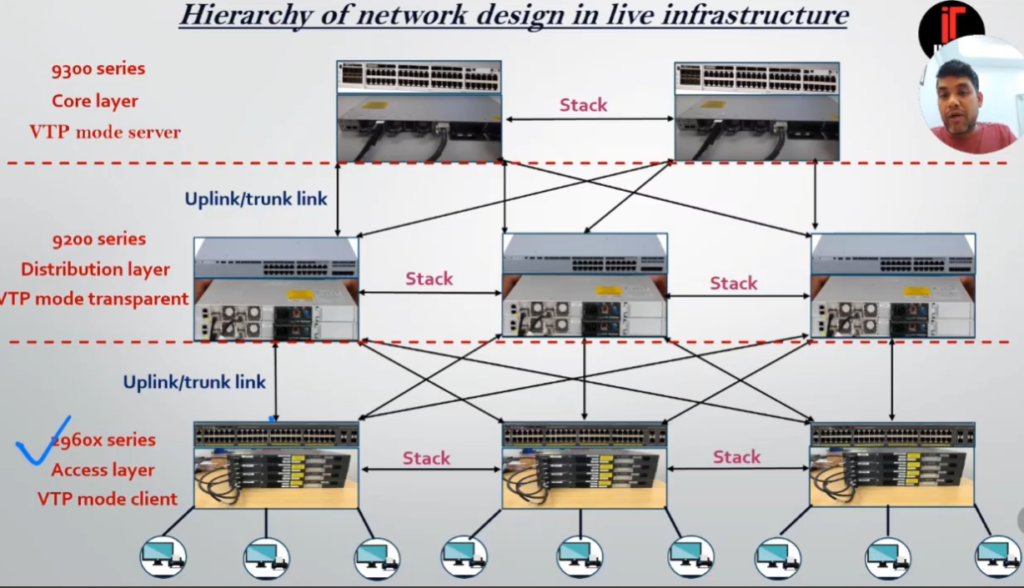
In a medium-sized company office, there are about 150 employees who use computers, IP phones, printers, and Wi-Fi access points. The IT department installs three 48-port managed switches in the server room. Instead of configuring and managing each switch separately, the switches are connected together using stacking cables and configured as a single switch stack. Now, all three physical switches behave like one logical switch with one management IP address and one configuration file.
For example, all employee PCs are connected across the three stacked switches, but VLANs for different departments such as HR, Finance, and IT are configured only once on the master switch and automatically applied to all member switches. If one switch in the stack fails due to power or hardware problems, the remaining switches continue to forward traffic without major interruption, and one of them automatically becomes the new master. Employees can continue working with little or no downtime.
This setup also makes future expansion easy for the company. When the business grows and more users are added, the IT team can simply add another switch to the existing stack instead of building a new network segment. The new switch immediately becomes part of the same logical system and follows the same security policies, VLANs, and management rules. In this way, switch stacking helps the company maintain a simple, reliable, and scalable network infrastructure with minimum management effort and maximum availability.
4 Switch Stacking
In a network where four switches are connected using switch stacking, STP (Spanning Tree Protocol does NOT block ports between the stacked switches) because the entire stack is treated as one single logical switch (one bridge ID). Since STP works based on bridge IDs, it does not see the individual stacked switches as separate devices. Therefore, there is no STP loop inside the stack, and all stack links remain active and forwarding traffic normally.
Regarding the control plane traffic, stacked switches continuously exchange control-plane information such as configuration data, MAC tables, routing information, and STP state through the dedicated stacking links. One switch acts as the master (or active switch) and manages the control plane for the whole stack. The other switches act as members and synchronize their control-plane information with the master. This internal control-plane traffic is handled automatically and does not interfere with normal user data traffic.
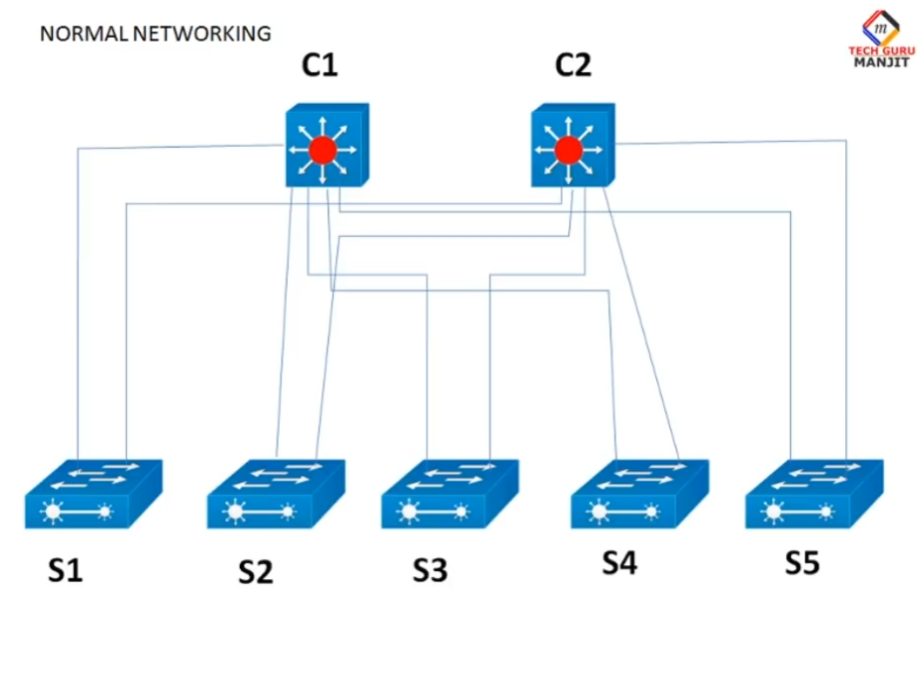
However, if those four switches are not stacked and are connected in a loop topology using normal Ethernet links, then STP will detect a loop and block one or more ports to prevent broadcast storms. In that case, STP does affect traffic flow by placing some ports in the blocking state. But in a true switch stack, STP treats the stack as one device, so no internal ports are blocked and performance is much better.
In summary, with switch stacking, STP does not block ports between the stacked switches, and control-plane traffic is managed internally by the master switch over high-speed stack links. This is one of the main advantages of switch stacking over connecting multiple independent switches with STP.
Types of Switch Stacking
There are different types of switch stacking, based on how switches are connected and how they operate as one logical unit. These types depend on the technology and vendor implementation. The main types of switch stacking are explained below.
1. Physical (True) Switch Stacking
In physical stacking, switches are connected using dedicated stacking ports and stacking cables. All switches operate as one logical switch with one control plane and one management IP address. One switch becomes the master and others become members. This type provides high bandwidth and fast failover. It is the most common and reliable form of switch stacking used in enterprise networks.
Example technologies:
- Cisco StackWise
- HPE IRF
- Juniper Virtual Chassis
2. Virtual Stacking (Logical Stacking)
In virtual stacking, switches are connected using normal Ethernet or fiber ports instead of special stacking cables. They still appear as one logical switch for management, but performance is usually lower than physical stacking. Control plane is shared logically, and the switches synchronize configurations over network links.
This is useful when stacking ports are not available or when switches are in different racks.
3. Ring Topology Stacking
In ring stacking, switches are connected in a closed loop (ring) using stacking cables. This provides redundancy, because if one stacking link fails, traffic can still flow in the opposite direction around the ring. It is the most fault-tolerant stacking topology and commonly used in production networks.
4. Chain (Linear) Topology Stacking
In chain stacking, switches are connected one after another in a straight line. It is simple to implement but has less redundancy. If a middle switch or stacking cable fails, the stack can split into two parts.
5. Vendor-Specific Stacking Types
Different vendors use their own stacking technologies:
- Cisco – StackWise / StackWise Virtual
- HPE – Intelligent Resilient Framework (IRF)
- Juniper – Virtual Chassis
- Dell – Dell EMC Stacking
Each vendor has limits on how many switches can be stacked and which models are compatible.
Switch Stacking Master And Slave
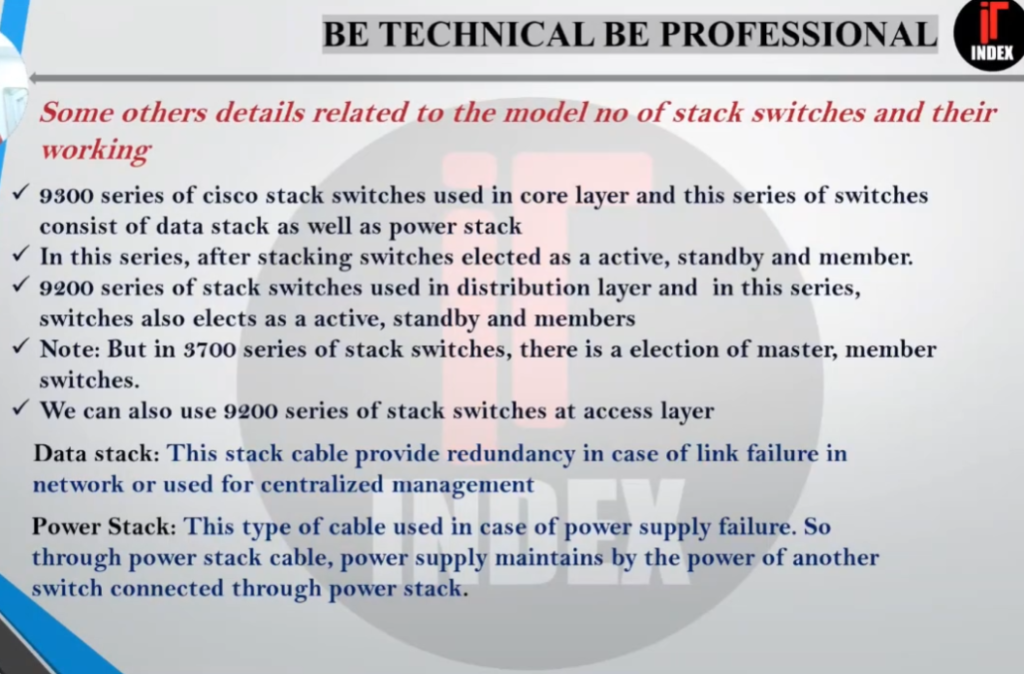
In switch stacking, multiple physical switches are combined to work as one logical switch. Among these switches, one is elected as the Master (or Active) switch, and the others become Slave (or Member) switches. This master–slave architecture allows the entire stack to be managed and controlled as a single device, which simplifies network operation and improves reliability.
The Master switch is the brain of the switch stack. It controls the control plane, which means it is responsible for running network protocols such as STP, VLAN management, routing (if Layer-3 is enabled), and link aggregation. The master also stores and applies the configuration for the whole stack and provides the single management IP address used by administrators. All decisions about how traffic should be forwarded inside and outside the stack are calculated by the master switch.
The Slave (Member) switches mainly handle the data plane, which is the actual forwarding of user traffic such as PC data, server traffic, and internet packets. They follow the instructions and configuration received from the master switch. Slave switches synchronize their MAC address tables, VLAN information, and port status with the master through the high-speed stacking links. From the administrator’s point of view, these slave switches do not act independently; they behave as line cards of one big switch.
A very important feature of master and slave operation is failover and redundancy. If the master switch fails due to power or hardware problems, one of the slave switches is automatically elected as the new master. This process usually happens quickly, and the network continues to function with minimal disruption. This ensures high availability and prevents long downtime in company or enterprise networks.
In summary, the master switch manages and controls the entire switch stack, while the slave switches forward traffic and follow the master’s configuration. Together, they act as one logical switch with centralized control, better performance, and built-in redundancy, making switch stacking a reliable and scalable solution for modern networks.


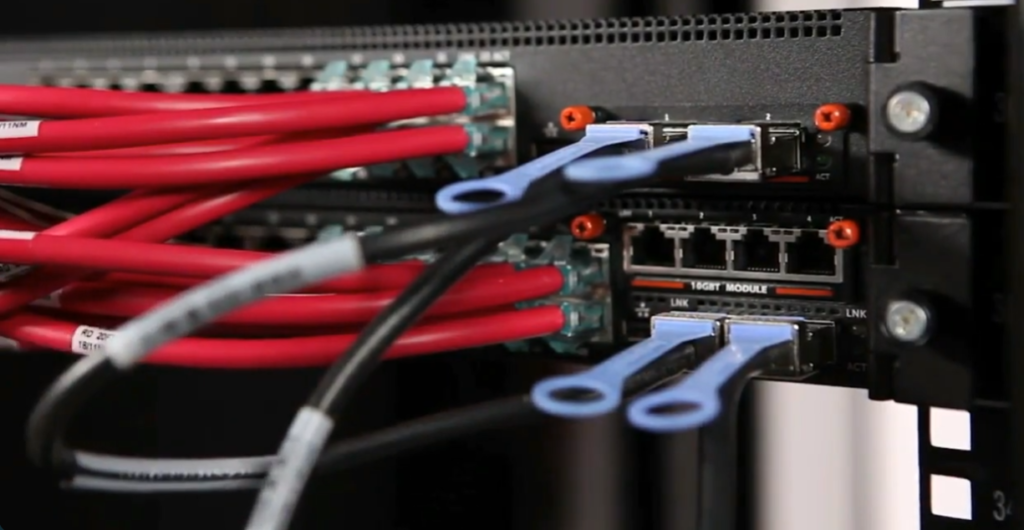
High Performance Stacking 40 Gbps Ethernet Capacity