
Ether-Channel Technology
What is Ether-Channel
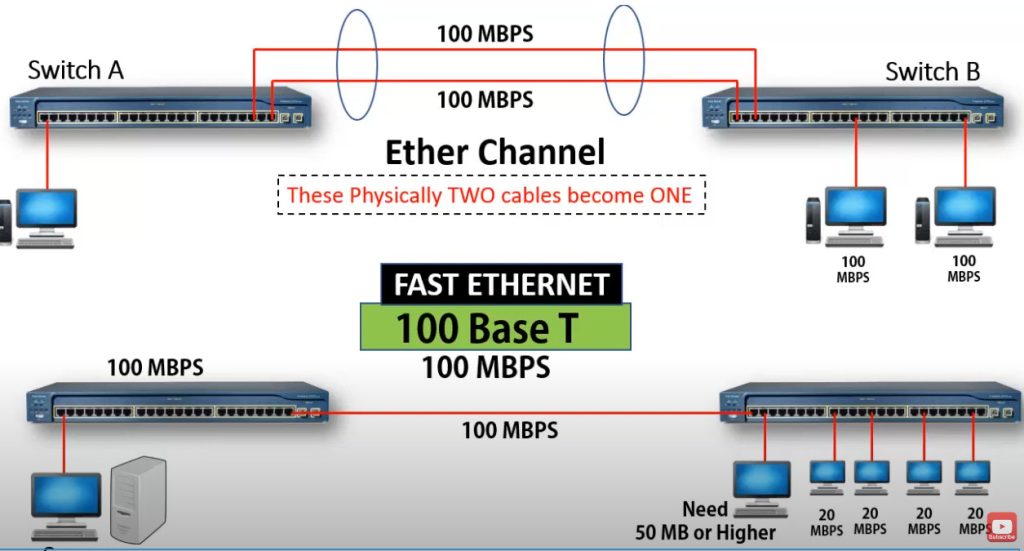
EtherChannel is a networking technology that combines multiple physical Ethernet links into one single logical link between two network devices such as switches, routers, or servers. Instead of using only one cable for communication, EtherChannel bundles two or more cables together so they act as one high-bandwidth and fault-tolerant connection. This increases overall network speed and also provides redundancy—if one physical link fails, traffic automatically continues through the remaining links without interrupting network communication.
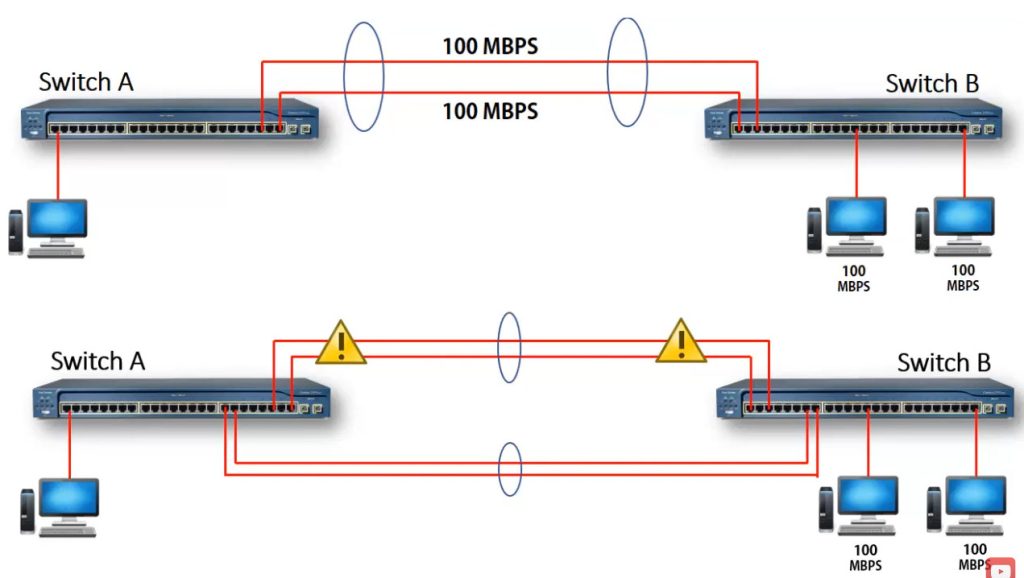
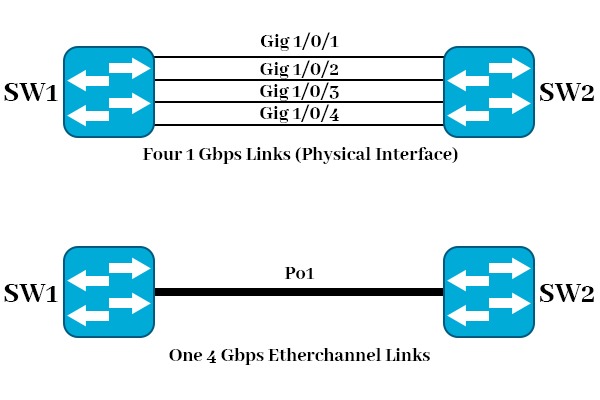
EtherChannel improves bandwidth and performance by load-balancing traffic across all member links. For example, if four 1-Gbps links are bundled, the total logical bandwidth becomes up to 4 Gbps. It also works well with Spanning Tree Protocol (STP) because STP treats the EtherChannel as a single link, preventing loop issues while still allowing full use of all bundled connections. Without EtherChannel, STP would block extra links, wasting bandwidth.
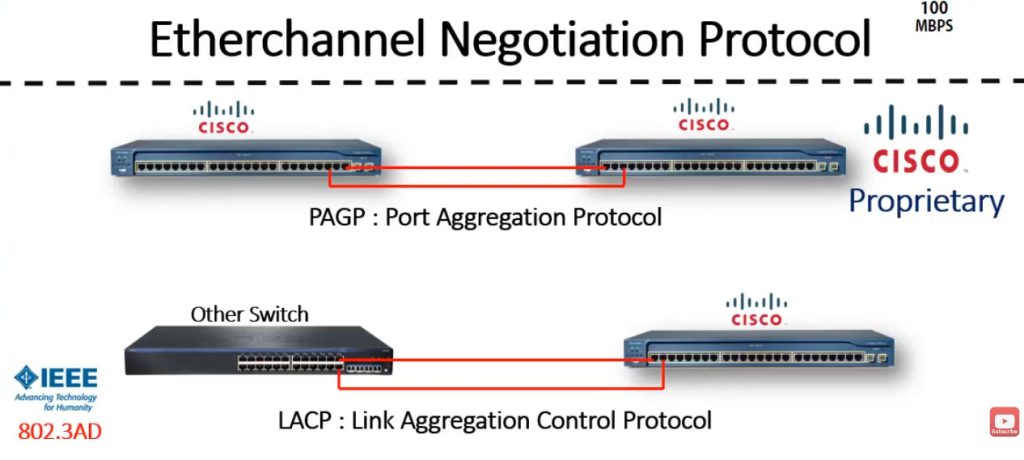
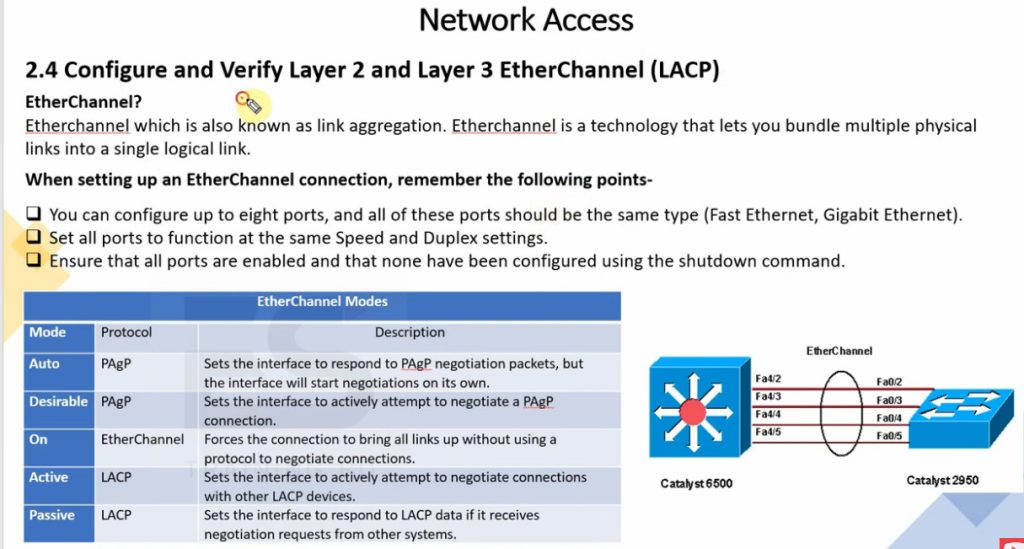
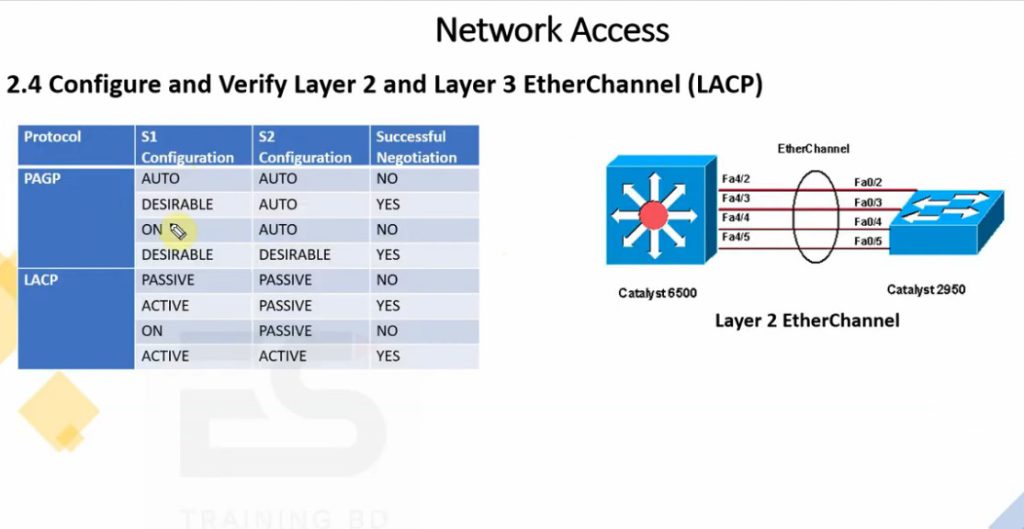
There are different methods to form EtherChannel. The most common are LACP (Link Aggregation Control Protocol), which is an open IEEE standard, and PAgP (Port Aggregation Protocol), which is Cisco-proprietary. There is also a manual mode called “on”, where links are forced into a channel without negotiation. All ports in an EtherChannel must have the same configuration (speed, duplex, VLAN settings, and trunk/access mode) to work properly.
EtherChannel is mainly used in company and data-center networks to connect switches, connect switches to routers, or connect servers that need high availability and high bandwidth. In summary, EtherChannel provides higher speed, redundancy, efficient use of links, and better network stability, making it an important technology in modern enterprise networks.
Why Need Ether-Channel
EtherChannel is needed to increase bandwidth, reliability, and network performance between important network devices such as switches, routers, and servers. In a company network, links between core switches or between a switch and a server often carry heavy traffic. Using only one cable can become a bottleneck and also creates a single point of failure. EtherChannel solves this by combining multiple physical links into one logical high-speed link.
Example:
Imagine a company has two switches (Switch A and Switch B) connected with only one 1-Gbps cable. Many users access servers through this link, so the connection becomes slow during busy hours. Also, if this single cable fails, the entire network connection between the switches goes down.
Now, the company connects four 1-Gbps cables between Switch A and Switch B and configures EtherChannel. These four cables act as one logical 4-Gbps link.
- If one cable fails, the other three still carry traffic (no network outage).
- Traffic is shared across all links, so performance improves.
- Spanning Tree Protocol treats it as one link and does not block any cable.
In simple words:
EtherChannel is needed to:
- Increase bandwidth (combine multiple links into one faster link)
- Provide redundancy (network stays up if one link fails)
- Prevent STP from blocking extra links
- Improve overall network stability
So, EtherChannel is used where high traffic and high availability are required, such as between core switches, distribution switches, and data center servers.
Ether-Channel Protocol
EtherChannel uses specific protocol types to form and manage the bundled links between network devices. The main EtherChannel protocol types are:
LACP (Link Aggregation Control Protocol)
This is an open standard protocol defined by IEEE 802.3ad (now part of 802.1AX). It allows switches and devices from different vendors to form an EtherChannel automatically. LACP checks link compatibility and helps prevent configuration errors. It is the most commonly used and recommended protocol.PAgP (Port Aggregation Protocol)
This is a Cisco-proprietary protocol used only on Cisco devices. It negotiates EtherChannel links between Cisco switches and ensures that the ports on both sides have matching configurations.Static (On Mode)
This is not a negotiation protocol but a manual configuration mode. In this mode, ports are forced into an EtherChannel without any protocol checking. It can cause network loops if misconfigured, so it is not recommended unless you are sure of the setup.
Summary:
- LACP – Standard, multi-vendor, safest and most popular
- PAgP – Cisco only
- On (Static) – No protocol, manual bundling
					Cisco Protocol PAGP
...................

Switch 1 Configuration

config t
int range fa0/1-2
channel-group 1 mode desirable


Switch 2 Configuration

config t
int range fa0/1-2
channel-group 1 mode auto


Checking Etherchannel Details Commnd

show etherchannel
show etherchannel summary
show interface etherchannel


IEE Protocol LACP
.................

Switch 1 Configuration

config t
int range fa0/1-2
channel-group 1 mode active


Switch 2 Configuration

config t
int range fa0/1-2
channel-group 1 mode passive


show etherchannel
show etherchannel summary
show interface etherchannel


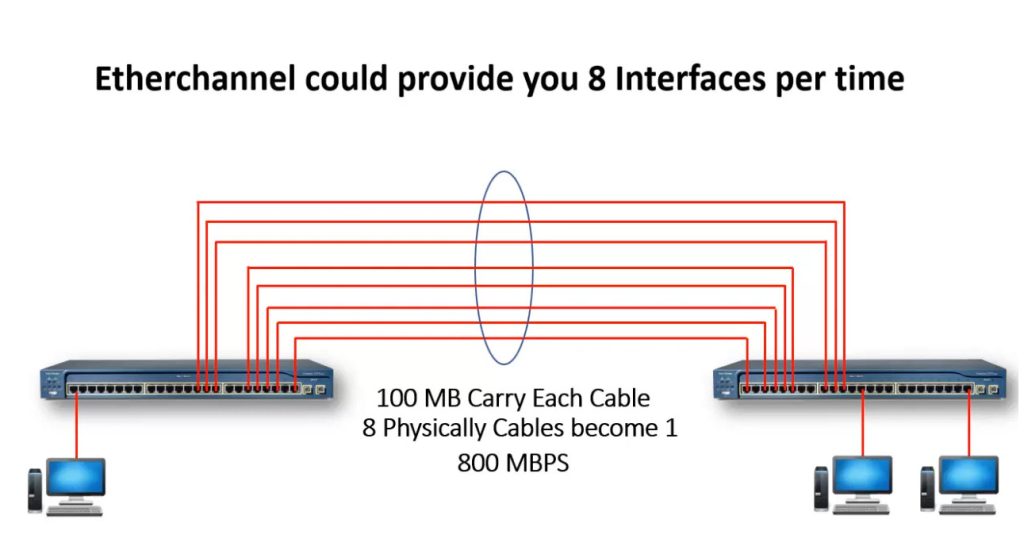
Notes- Maximum 8 Port Bandil For Etherchannel);
Real-World Applications of EtherChannel
EtherChannel has numerous real life applications in enterprise, data centers, and cloud computing technologies to enhance network efficiency, flexibility, and reliability.
1. Data centers and enterprise networks
- EtherChannel is useful for the high-speed backbone connections within the core, distribution and access layers of enterprise networks.
- EtherChannel is also used for load balancing and redundancy of server-to-switch connections.
2. Service provider networks
- ISPs use EtherChannel to bundle multiple links between a router and switch, increasing bandwidth available to customers.
- Provides an improved WAN connection by combining multiple circuits into a single logical circuit.
3. Cloud computing environments
- In cloud data centers, EtherChannel is used to connect virtualized environments with physical switches.
- Offers seamless failover and uninterrupted service for cloud applications.
Frequently Asked Questions
Q1. What are the 3 types of EtherChannel?
Three types of EtherChannel in networking are:
- PAgP: It is a Cisco-proprietary protocol.
- LACP: IEEE Standard Protocol.
- Manual: It is manually configured on each switch.
Q2. What do you mean by EtherChannel?
EtherChannel is a link aggregation technology that is mainly used to link more than one physical port link into a single logical link.
Q3. What is port channel vs EtherChannel?
A port channel is a logical interface that represents a group of physical links aggregated together. EtherChannel in networking is a Cisco term for link aggregation technology that bundles multiple links into one logical link.
Q4. Why is LACP used?
LACP is used to combine multiple physical links into one logical link for higher bandwidth and redundancy.
EtherChannel Interview Questions
Here are common EtherChannel Interview Questions and Answers (Q&A) that are frequently asked in networking interviews (CCNA / Network Engineer level):
Basic EtherChannel Q&A
1. What is EtherChannel?
EtherChannel is a technology that combines multiple physical Ethernet links into one logical link to increase bandwidth and provide redundancy between network devices.
2. Why is EtherChannel used?
To increase bandwidth, provide link redundancy, prevent STP from blocking links, and improve network performance.
3. How many ports can be bundled in EtherChannel?
Up to 8 active links can be bundled into one EtherChannel group.
4. Which protocols are used in EtherChannel?
- LACP (Link Aggregation Control Protocol)
- PAgP (Port Aggregation Protocol – Cisco proprietary)
- On mode (static, no protocol)
5. What is LACP?
LACP is an IEEE standard protocol (802.3ad / 802.1AX) used to dynamically form EtherChannel between devices.
6. What is PAgP?
PAgP is a Cisco-proprietary protocol that negotiates EtherChannel between Cisco switches.
7. Difference between LACP and PAgP?
LACP is an open standard; PAgP works only on Cisco devices.
8. What is load balancing in EtherChannel?
Traffic is distributed across multiple links based on MAC address, IP address, or port number.
9. What happens if one link fails in EtherChannel?
Traffic continues on remaining links without network downtime.
10. Does STP block EtherChannel links?
No. STP treats EtherChannel as a single logical link.
Configuration & Technical Q&A
11. What conditions must match for EtherChannel?
All ports must have the same:
- Speed and duplex
- VLAN configuration
- Trunk or access mode
- Native VLAN
- Allowed VLANs
12. What is “on” mode in EtherChannel?
Manual mode where ports are forced into EtherChannel without negotiation.
13. Which is the safest EtherChannel mode?
LACP because it prevents misconfiguration.
14. Can EtherChannel work between different vendors?
Yes, if LACP is used.
15. Can EtherChannel be used on access ports?
Yes, EtherChannel can be configured on access ports and trunk ports.
16. What is a Port-Channel?
The logical interface created after EtherChannel configuration.
17. What happens if VLANs don’t match on both sides?
EtherChannel will fail and ports may go into suspended state.
18. Is EtherChannel a Layer 2 or Layer 3 technology?
It can be both Layer 2 and Layer 3.
19. What command shows EtherChannel status?
show etherchannel summary
20. What is the advantage of EtherChannel over single link?
Higher bandwidth, redundancy, and better link utilization.
Scenario-Based Q&A
21. If one cable is removed from EtherChannel, will traffic stop?
No, traffic continues on remaining links.
22. Why STP is not blocking EtherChannel links?
Because STP sees EtherChannel as one logical link.
23. What happens if “on” mode is misconfigured?
It can cause network loops and broadcast storms.
24. Where is EtherChannel commonly used?
Between core-distribution switches, switch-to-switch links, and server connections.
25. Which load-balancing method is best?
Depends on traffic type (MAC-based or IP-based hashing).