Layer 3 VPN (L3VPN)
Table of Contents
What is Layer 3 VPN (L3VPN)
A Layer 3 VPN (L3VPN) is a type of Virtual Private Network that connects multiple locations at the network layer (Layer 3), allowing communication based on IP routing instead of Ethernet frames. In L3VPN, each site has its own separate network, and routing is used to exchange data between them securely.
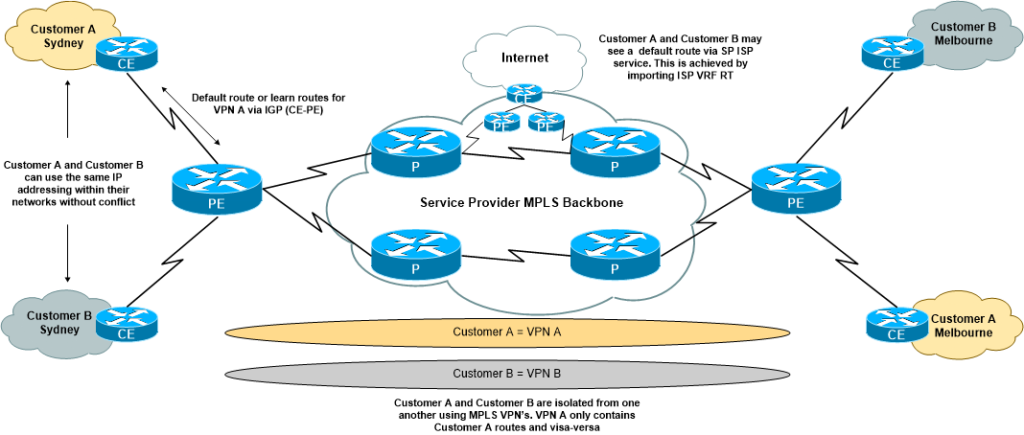
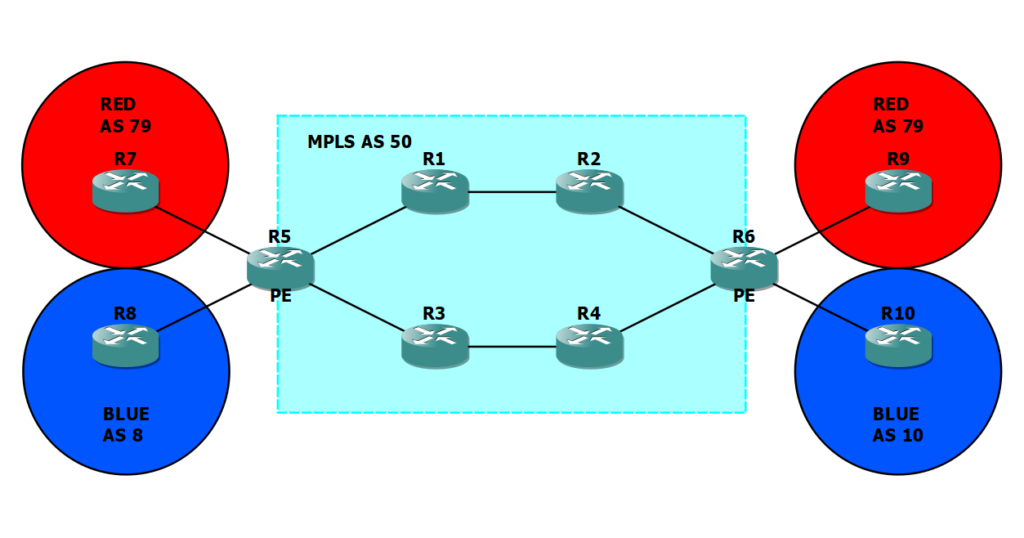
In an L3VPN, service providers typically use technologies like MPLS to create secure and isolated paths for customer traffic. Customer routers (CE devices) connect to provider routers (PE devices), and the provider handles routing between sites using mechanisms like VRF (Virtual Routing and Forwarding). This ensures that each customer’s data remains separate and secure.
Unlike Layer 2 VPN, which extends a LAN, an L3VPN connects different networks using routing protocols such as OSPF, BGP, or static routing. This makes it more scalable and efficient for large networks, as it reduces broadcast traffic and improves performance.
L3VPN is widely used by enterprises, ISPs, and banks to connect headquarters, branch offices, and data centers. It allows secure communication, centralized control, and efficient routing between multiple sites without exposing data to the public internet.
In summary, a Layer 3 VPN provides secure, scalable, and efficient network connectivity using IP routing, making it ideal for organizations with multiple locations that need reliable communication between different networks.
Why L3VPN is Needed
A Layer 3 VPN (L3VPN) is needed when organizations want to connect multiple office networks using IP routing in a secure, scalable, and efficient way. It is widely used in enterprises, banks, and service provider networks to manage communication between different locations.
Why L3VPN is Needed :
One of the main reasons for using an L3VPN is secure communication between sites. It allows different office networks to exchange data safely using technologies like MPLS, ensuring that traffic is isolated and protected from other users.
L3VPN is required for connecting multiple branch offices. Each branch can have its own IP network, and routing is used to communicate between them. This is more flexible than Layer 2 VPN, as it does not require all sites to be in the same broadcast domain.
Another important reason is scalability. L3VPN can easily support a large number of sites without increasing broadcast traffic. Since it uses routing instead of Layer-2 switching, it performs better in large enterprise networks.
It also provides efficient traffic management. Routing protocols like OSPF or BGP can be used to select the best path for data, improving performance and reliability across the network.
L3VPN helps in network isolation and security. Using concepts like VRF (Virtual Routing and Forwarding), multiple customers or departments can use the same provider network while keeping their data completely separate.
It reduces network complexity for customers. The service provider manages the core network and routing, so the organization does not need to maintain a complex WAN infrastructure.
Another key reason is support for modern applications. L3VPN works well with IP-based services such as cloud applications, VoIP, video conferencing, and enterprise software.
L3VPN Protocols
L3VPN Protocols:
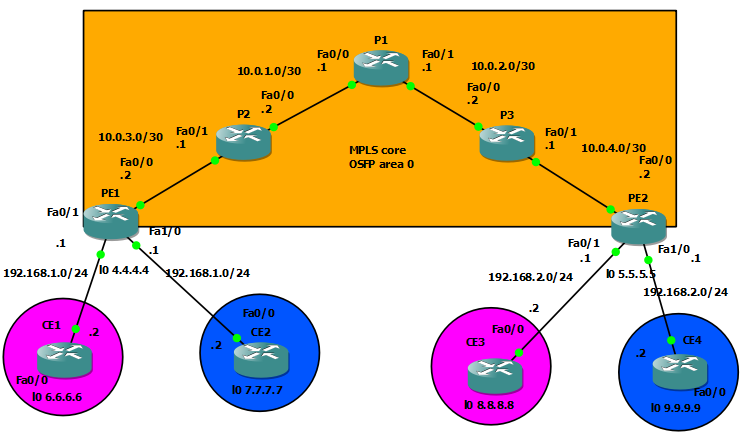
The most important protocol in L3VPN is MPLS. It forms the backbone of many service provider VPNs by forwarding packets using labels instead of traditional IP lookups. This improves speed and allows multiple customers to share the same infrastructure securely.
For exchanging VPN routes across the network, BGP (specifically MP-BGP) is used. It carries routing information between provider routers and ensures that each site can reach other sites within the same VPN.
Between the customer and provider routers, routing protocols like OSPF, EIGRP, and RIP can be used. These help exchange routing information and determine the best path for data.
For tunneling, GRE is often used. It creates a virtual tunnel that can carry different types of traffic, including routing protocols. However, GRE does not provide security.
To secure the data, IPsec is used. It encrypts the traffic so that it remains confidential while traveling over public networks. GRE and IPsec are often combined for both tunneling and security.
In large enterprise networks, DMVPN is used. It combines GRE, IPsec, and NHRP to provide scalable and dynamic VPN connectivity between multiple branch offices.
Inside MPLS networks, LDP and RSVP-TE are used to distribute labels and manage traffic paths efficiently.
Difference Between Layer 2 VPN and Layer 3 VPN
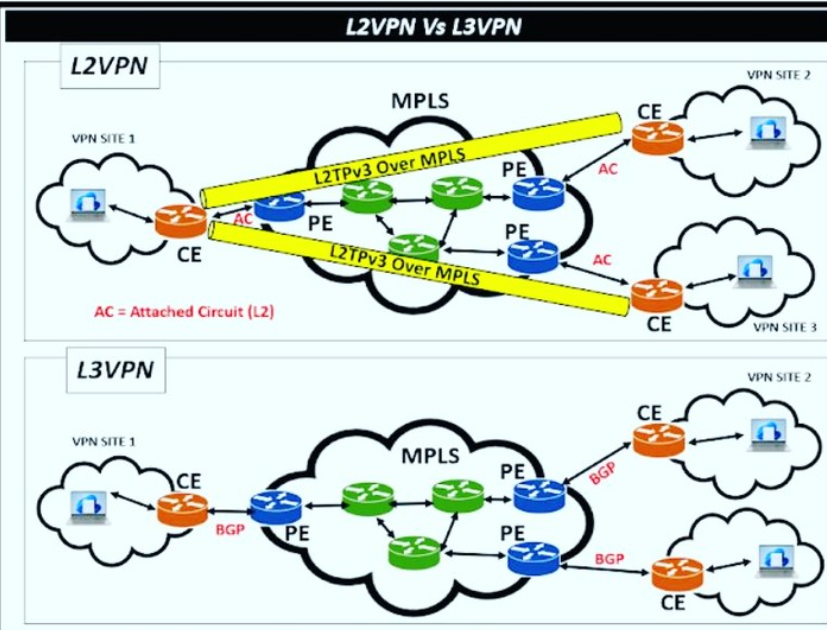
A Layer 2 VPN (L2VPN) works at the data link layer and extends a company’s LAN across multiple locations. It carries Ethernet Frames using technologies like MPLS, making remote sites behave as if they are connected to the same switch. This is useful for VLAN extension and applications that require Layer-2 communication.
On the other hand, a Layer 3 VPN (L3VPN) works at the network layer and connects different networks using IP Routing. It uses MPLS along with BGP to route traffic between sites. Each location has its own subnet, and routing protocols decide the best path for data.
In simple terms, L2VPN = extend LAN, while L3VPN = connect networks using routing. L2VPN is ideal for LAN extension, whereas L3VPN is better for large, scalable enterprise networks.
A company has a Head Office in Kolkata and a Branch Office in Haldia. The company wants both offices to operate as if they are on the same Local Area Network (LAN). The service provider delivers a VPWS connection between the two sites.
					        Head Office                        Branch Office

PC1 192.168.10.10  ===== VPWS =====  PC2 192.168.10.20
        |                                 |
     Switch                            Switch
        |                                 |
 File Server 192.168.10.100
How It Works
An employee in the Branch Office opens a shared folder stored on the File Server in the Head Office. The Ethernet frame is carried across the VPWS connection and delivered to the Head Office without any IP routing. Since both offices are in the same subnet (192.168.10.0/24), they behave as if they are connected by a single Ethernet cable.
The same company now uses an MPLS Layer 3 VPN. Each office has its own subnet, and routing is performed by routers.
					        Head Office                    Branch Office

PC1                                PC2
192.168.10.10                  192.168.20.20
      |                               |
   Router                         Router
192.168.10.1                  192.168.20.1
        \                       /
         \____ MPLS L3VPN _____/
How It Works
An employee in the Head Office wants to access a server in the Branch Office. The PC sends the packet to its default gateway (192.168.10.1). The router forwards the packet through the MPLS Layer 3 VPN to the Branch Office router, which then delivers it to the destination device (192.168.20.20). The response follows the same route back to the Head Office.
Key Difference
| Layer 2 (VPWS/VPLS) | Layer 3 (MPLS L3VPN) |
|---|---|
| Same subnet at both sites | Different subnet at each site |
| No routing between sites | Routing is required |
| Extends the Ethernet LAN | Connects different IP networks |
| Example: 192.168.10.0/24 at both offices | Example: HO = 192.168.10.0/24, Branch = 192.168.20.0/24 |
Simple Summary:
- Layer 2: Head Office and Branch Office appear to be on the same LAN.
- Layer 3: Head Office and Branch Office are on different networks, and communication is handled through IP routing.
Difference Between Layer 2 VPN and Layer 3 VPN:
| Feature | Layer 2 VPN (L2VPN) | Layer 3 VPN (L3VPN) |
|---|---|---|
| OSI Layer | Data Link Layer (Layer 2) | Network Layer (Layer 3) |
| Data Handling | Ethernet frames (MAC-based) | IP packets (routing-based) |
| Network Type | Extends same LAN | Connects different networks |
| Technology | MPLS (VPWS, VPLS, EVPN) | MPLS + BGP |
| Routing | No routing (Layer 2 switching) | Uses routing (OSPF, BGP, etc.) |
| Broadcast Domain | Same broadcast domain | Separate broadcast domains |
| Control | Customer controls network | Provider can manage routing |
| Scalability | Limited (broadcast traffic increases) | High scalability |
| Use Case | VLAN extension, data center, LAN extension | Enterprise WAN, banking, ISP networks |
| Example | Same VLAN across offices | Different IP subnets connected |