
EPON,GPON,and XPON
What is PON Technology?
PON (Passive Optical Network) is a fiber-optic access network technology used to provide Internet, IPTV, and Voice (Triple Play) from a service provider to many users using one single optical fiber and passive splitters (no power required in between).
Main Components of PON
The main components of a PON (Passive Optical Network) are OLT (Optical Line Terminal), Optical Fiber Cable, Passive Optical Splitter, and ONU/ONT (Optical Network Unit/Optical Network Terminal), where the OLT is installed at the service provider’s central office and works as the brain of the PON system by generating optical signals, managing bandwidth allocation, controlling upstream and downstream communication, authenticating users, and providing interfaces to core networks such as Internet, VoIP, and IPTV; the Optical Fiber Cable acts as the transmission medium that carries optical signals over long distances with very low loss and connects the OLT to the splitter and then to end users; the Passive Optical Splitter is a key field component that divides a single optical signal from the OLT into multiple signals (for example 1:8, 1:16, 1:32, or 1:64,1:128) without using any electrical power and distributes the same data stream to many customers; and the ONU/ONT, which is installed at the customer premises, receives the optical signal from the fiber, converts it into electrical Ethernet signals for computers, routers, televisions, and phones, and sends upstream data back to the OLT, thus completing the communication path between the service provider and the end user in a PON system.
Type of PON Technology
PON (Passive Optical Network) technology has evolved over time to support higher bandwidth and more users. Different types of PON technologies are defined by international standards bodies such as ITU-T and IEEE. Each type is designed for specific speed requirements, services, and deployment scenarios. The main types of PON technology include APON/BPON, EPON, GPON, XG-PON, XGS-PON, and 10G-EPON, with newer technologies like 25G-PON and 50G-PON also emerging. These technologies differ mainly in data rates, wavelength usage, and performance capabilities.
APON (ATM Passive Optical Network) was the first PON standard developed by ITU-T. It used ATM (Asynchronous Transfer Mode) technology and supported relatively low data rates compared to modern systems. APON was later improved and renamed BPON (Broadband PON), which provided higher speeds and support for broadband services such as internet and video. However, BPON is now largely obsolete due to limited bandwidth and the availability of more advanced PON technologies.
EPON (Ethernet Passive Optical Network) is standardized by IEEE under the 802.3ah specification. It uses Ethernet frames directly, making it simple and cost-effective to integrate with existing Ethernet networks. EPON typically provides symmetrical speeds of up to 1.25 Gbps downstream and upstream. It is widely used in some regions, especially in Asia, for FTTH deployments because of its flexibility and lower cost.
GPON (Gigabit Passive Optical Network) is one of the most popular PON technologies and is standardized by ITU-T G.984. It supports data rates of 2.5 Gbps downstream and 1.25 Gbps upstream. GPON can serve up to 64 users from a single fiber using passive splitters and supports multiple services such as internet, IPTV, and VoIP. Because of its good balance between performance and cost, GPON has been widely adopted for FTTH networks around the world.
XG-PON (10-Gigabit Passive Optical Network) is the next generation after GPON and is standardized under ITU-T G.987. It increases the downstream speed to 10 Gbps while keeping upstream at 2.5 Gbps. XG-PON was designed to support higher user demand and bandwidth-intensive services while maintaining compatibility with existing GPON infrastructure.
XGS-PON (10-Gigabit Symmetric PON) is an enhanced version of XG-PON defined in ITU-T G.9807.1. It provides 10 Gbps downstream and 10 Gbps upstream, making it suitable for applications that require high upload speeds such as cloud computing, video conferencing, and enterprise services. XGS-PON can coexist with GPON on the same fiber using different wavelengths, making it a popular choice for network upgrades.
10G-EPON (10-Gigabit Ethernet PON) is the IEEE-based equivalent of XGS-PON and is standardized under IEEE 802.3av. It supports 10 Gbps downstream and 10 Gbps upstream and uses Ethernet framing. It is commonly used in enterprise and carrier networks where Ethernet integration is preferred.
Next-generation PON technologies include 25G-PON, 50G-PON, and 100G-PON, which are being developed to support future bandwidth needs such as 8K video, virtual reality, smart cities, and massive IoT. These technologies offer much higher speeds while continuing to use passive optical network architecture and existing fiber infrastructure as much as possible.
In summary, the main types of PON technology are APON/BPON, EPON, GPON, XG-PON, XGS-PON, 10G-EPON, and next-generation PON such as 25G-PON and 50G-PON. Each generation improves speed, efficiency, and service capability, making PON a continuously evolving technology for high-speed broadband access networks.
What is EPON?
EPON (Ethernet Passive Optical Network) is a fiber-optic access network technology standardized by IEEE (802.3ah / 802.3av) that uses Ethernet frames to deliver high-speed Internet and data services from a service provider to multiple users through a single optical fiber and passive splitters.
It is called Passive because there are no powered devices between the service provider (OLT) and the customer (ONU/ONT); only passive optical splitters are used.
Main Components of EPON
OLT (Optical Line Terminal) – Installed at ISP central office, controls the EPON network and connects it to the Internet backbone.
Optical Fiber Cable – Carries optical signals between OLT and users.
Passive Optical Splitter – Divides one fiber into many (1:8, 1:16, 1:32, 1:64).
ONU / ONT (Optical Network Unit/Terminal) – Installed at customer side, converts optical signals into electrical Ethernet signals for user devices.
- Industry standard: IEEE 802.3ah
- Bandwidth: Symmetrical 1.25 Gbps.
- Features: Uses Ethernet frames, making it compatible with existing networks.
- Applications: Popular in Asia for residential and business Ethernet services.
Wavelengths Used in EPON
| Direction | Wavelength |
|---|---|
| Downstream | 1490 nm |
| Upstream | 1310 nm |
| Video (optional) | 1550 nm |
EPON Speed and Capacity
- Standard EPON: 1.25 Gbps downstream & 1.25 Gbps upstream (symmetric)
- 10G EPON: 10 Gbps downstream & 10 Gbps upstream (or 10/1 Gbps)
- Supports up to 64 users per OLT port
- Maximum distance: 20–40 km
Security in EPON
- Uses AES encryption
- Each ONU can only access its own data
- Prevents data theft between users
Features of EPON
- Ethernet-based (easy integration with LAN/WAN)
- High bandwidth
- Long distance coverage
- Low maintenance (passive network)
- Scalable and cost-effective
- Supports voice, data, and video
What is GPON?
GPON stands for Gigabit Passive Optical Network, a widely used fiber-access technology under the Passive Optical Network (PON) family. Unlike traditional copper-based broadband, GPON uses fiber-optic cabling with passive optical splitters to efficiently share a single fiber among multiple end users. This makes it ideal for FTTH and other FTTx deployments.
Standardized by the ITU-T in 2004 and backed by the Full Service Access Network (FSAN) group, GPON combines high speeds, cost efficiency, and scalability, meeting the demand for gigabit-level connectivity worldwide.
Key Features of GPON:
- High Speed: Up to 2.4 Gbps downstream and 1.2 Gbps upstream.
- Triple-Play Support: Voice (VoIP), video (IPTV), and internet.
- Long Reach: Coverage up to 20km without signal loss.
- Secure Transmission: Strong encryption safeguards user data.
These features explain why GPON remains the dominant standard for next-generation broadband networks.
How Does GPON Work
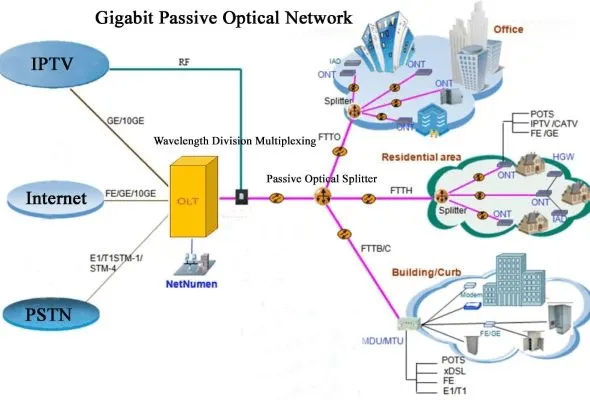
GPON uses a point-to- multipoint model, allowing a single fiber from the central office to serve many users through passive optical splitters. These splitters do not require power, which reduces operational costs and simplifies maintenance.
A typical GPON includes three components:
- Optical Line Terminal (OLT): The control hub located at the provider’s central office. It manages upstream and downstream traffic, converting electrical signals to optical signals and vice versa.
- Optical Splitter: A passive device that divides the optical signal from the OLT to reach multiple premises. It requires no power, reducing operational costs.
- Optical Network Terminal (ONT) or ONU: Installed at the end user’s side. It receives the optical signal and converts it to electrical signals for local devices like routers, phones, or TVs.
Why Choose GPON
With the demand for high-speed connectivity, network operators and enterprises require solutions that offer speed, scalability, and cost efficiency. GPON provides these benefits effectively.
High-Speed Performance
GPON offers reliable bandwidth with 2.4 Gbps downstream and 1.2 Gbps upstream per PON port. This allows users to enjoy high-definition streaming, cloud-based services, and stable video conferencing without lag. The built-in Quality of Service mechanisms in GPON help prioritize real-time services, including VoIP and IPTV, ensuring a smooth user experience even during peak usage times.
Cost Efficiency
GPON’s point-to-multipoint structure reduces the amount of fiber and electronic equipment needed compared to point-to-point Ethernet. One fiber and an optical splitter can serve multiple users, significantly lowering deployment and maintenance costs. Passive splitters require no power, reducing energy consumption and operational expenses, making GPON a practical option for ISPs and developers looking to expand broadband coverage affordably.
Security and Reliability
GPON uses strong encryption protocols to secure data transmissions, protecting user information and ensuring privacy. Fiber-optic cables are immune to electromagnetic interference, providing stable and reliable connectivity in various environments. Centralized management of GPON networks allows operators to monitor network performance and address issues promptly, maintaining consistent service quality for end users.
Comparing GPON to Other PON Standards
Many network planners compare GPON with other PON technologies such as EPON, XG-PON, and XGS-PON. Each technology has different speed capabilities and is suitable for various applications.
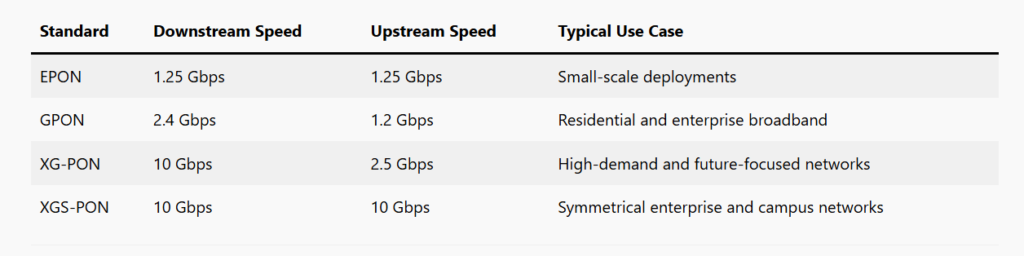
GPON offers dynamic bandwidth allocation and quality of service features, making it more suitable for real-time applications such as IPTV and VoIP. It is a reliable and scalable choice for service providers aiming to deliver high-speed broadband while managing network resources efficiently.
GPON (Gigabit PON)
- Industry standard: ITU-T G.984.x
- Bandwidth: 2.5 Gbps downstream, 1.25 Gbps upstream.
- Features: GPON is more efficient for high-bandwidth services like IPTV, VoIP, and 4K streaming.
- Applications: Considered the best solution for high-demand services like FTTH and high-speed broadband.
Conclusion:
- EPON is best for scenarios that prioritize cost-effectiveness and simplicity while providing decent bandwidth for typical broadband applications.
- GPON offers higher performance and is suited for more demanding applications such as IPTV, VoIP, and other high-bandwidth services.
- XPON is a term that usually refers to 10G-PON solutions or multigigabit PON technologies, which can include both EPON and GPON in their 10 Gbps forms.
Each of these technologies has its own strengths, and the choice between them depends on the specific needs of the service provider and the end-user, such as the desired bandwidth, distance, and the complexity of the network deployment.
What is XG-PON
XG-PON (10-Gigabit Passive Optical Network) is an advanced fiber-optic broadband technology defined by the ITU-T standard G.987. It is an upgrade of GPON and is designed to deliver much higher internet speeds to support modern services such as 4K/8K video streaming, cloud computing, online gaming, smart homes, and enterprise connectivity.
XG-PON provides 10 Gbps downstream (download) and 2.5 Gbps upstream (upload) bandwidth over a passive optical network, meaning no powered equipment (like switches or amplifiers) is required between the service provider and the customer—only passive optical splitters are used. This makes XG-PON highly reliable, energy-efficient, and cost-effective for large-scale deployments.
1. Basic Concept of XG-PON
XG-PON works on a point-to-multipoint architecture:
- One optical fiber from the service provider’s central office is shared by many users.
- The fiber is split using passive splitters (1:16, 1:32, or 1:64).
- Each user receives a dedicated logical connection using encryption and time-division multiplexing.
This allows operators to serve dozens of customers using a single fiber strand while still providing high bandwidth.
2. Main Components of XG-PON
1. OLT (Optical Line Terminal)
- Located at the service provider’s central office or exchange.
- Controls the entire XG-PON network.
- Manages bandwidth allocation, authentication, and traffic scheduling.
- Sends downstream data at 10 Gbps and receives upstream data at 2.5 Gbps.
2. ODN (Optical Distribution Network)
This is the passive fiber network between OLT and users. It includes:
- Optical fiber cables
- Passive optical splitters (1:2, 1:4, 1:8, 1:16, 1:32, 1:64)
- Connectors and splice closures
No electrical power is required in the ODN.
3. ONT / ONU (Optical Network Terminal / Unit)
- Installed at the customer premises.
- Converts optical signals into electrical signals (Ethernet, Wi-Fi, VoIP).
- Connects customer devices such as computers, routers, TVs, and IP phones.
3. Speed and Wavelengths in XG-PON
XG-PON uses different wavelengths for upstream and downstream traffic:
| Direction | Speed | Wavelength |
|---|---|---|
| Downstream | 10 Gbps | 1577 nm |
| Upstream | 2.5 Gbps | 1270 nm |
This wavelength separation allows bidirectional communication over a single fiber strand without interference.
4. Transmission Method
Downstream (OLT → ONT)
- Broadcast method: OLT sends data to all ONTs.
- Each ONT reads only the data addressed to it using encryption (AES-128).
- Uses TDM (Time Division Multiplexing).
Upstream (ONT → OLT)
- Uses TDMA (Time Division Multiple Access).
- Each ONT transmits data in assigned time slots to avoid collision.
- OLT controls timing and bandwidth using Dynamic Bandwidth Allocation (DBA).
5. Key Features of XG-PON
- High speed: 10 Gbps download, 2.5 Gbps upload
- Backward compatible: Can coexist with GPON on the same fiber (using different wavelengths)
- Long distance: Up to 20–40 km coverage
- High split ratio: Up to 1:64 users per fiber
- Secure: AES-128 encryption
- QoS support: For voice, video, and data services
- Low power consumption: Passive network elements
6. Services Supported by XG-PON
XG-PON supports multiple triple-play and quad-play services:
- High-speed Internet (FTTH)
- IPTV and Video on Demand
- VoIP and video calling
- Cloud services
- Online gaming
- Smart home and IoT
- Business VPN and leased-line-like services
7. XG-PON vs GPON vs XGS-PON
| Feature | GPON | XG-PON | XGS-PON |
|---|---|---|---|
| Downstream | 2.5 Gbps | 10 Gbps | 10 Gbps |
| Upstream | 1.25 Gbps | 2.5 Gbps | 10 Gbps |
| Standard | ITU-T G.984 | ITU-T G.987 | ITU-T G.9807.1 |
| Use case | Basic FTTH | Higher speed FTTH | Symmetric high-speed FTTH |
- Advantages of XG-PON
- Much higher bandwidth than GPON
- Uses existing fiber infrastructure
- Scalable for future upgrades
- Supports many users efficiently
- Ideal for 4K/8K streaming and business customers
Conclusion
XG-PON is a next-generation fiber broadband technology that significantly improves speed and performance compared to GPON. It is designed to meet the growing demand for high-bandwidth applications while keeping the network simple, secure, and cost-effective. It acts as a bridge between traditional GPON and fully symmetric ultra-high-speed technologies like XGS-PON and 10G-PON.
What is XGS-PON
XGS-PON (10-Gigabit Symmetric Passive Optical Network) is an advanced fiber-optic access technology used by Internet Service Providers (ISPs) to deliver ultra-high-speed broadband services to homes, businesses, and mobile networks. It is an evolution of earlier PON technologies such as GPON and XG-PON and was standardized by ITU-T under recommendation G.9807.1. The main objective of XGS-PON is to meet the rapidly growing demand for bandwidth caused by cloud computing, 4K/8K video streaming, online gaming, remote work, smart devices, and enterprise applications. The term “XGS” indicates that the system supports 10 Gbps downstream and 10 Gbps upstream, meaning it provides symmetric data rates, which is a major improvement over GPON and XG-PON that offer lower upstream speeds.
XGS-PON operates on a Passive Optical Network architecture, which means it uses optical fiber and passive splitters without any powered equipment between the service provider’s central office and the customer. The network is built around three main components: the Optical Line Terminal (OLT) located at the ISP’s central office, optical splitters placed in the distribution network, and the Optical Network Terminal (ONT/ONU) installed at the customer premises. A single fiber from the OLT is divided by passive splitters into multiple fibers, typically serving 32 or 64 users from one OLT port. This point-to-multipoint design reduces infrastructure cost while efficiently sharing high bandwidth among many subscribers.
In XGS-PON, data transmission is carried using specific optical wavelengths to avoid interference with other PON systems. The downstream traffic from the OLT to the ONTs uses a wavelength of 1577 nm, while upstream traffic from ONTs to the OLT uses 1270 nm. This separation of wavelengths allows XGS-PON to coexist with GPON on the same physical fiber network, enabling service providers to upgrade their networks gradually without replacing existing fiber cables. The system supports a maximum transmission distance of up to 40 kilometers, which makes it suitable for both urban and rural deployments.
The working principle of XGS-PON is based on time division multiplexing (TDM) and time division multiple access (TDMA). In the downstream direction, the OLT broadcasts data to all connected ONTs, but each ONT extracts only the data intended for it using encryption and addressing mechanisms. In the upstream direction, multiple ONTs share the same fiber by transmitting data in assigned time slots, which are controlled by the OLT using dynamic bandwidth allocation (DBA). This ensures fair and efficient use of bandwidth and prevents data collisions between different users.
One of the key advantages of XGS-PON is its symmetric high bandwidth, which is especially important for modern applications that require high upload speeds, such as video conferencing, cloud storage, live streaming, and enterprise networking. It also provides low latency and high reliability, making it suitable for services like VoIP, IPTV, online gaming, and 5G mobile backhaul. Because the network uses passive splitters instead of active electronic devices in the field, power consumption and maintenance costs are lower compared to traditional copper-based or active Ethernet networks.
XGS-PON is widely used in FTTH (Fiber to the Home) and FTTB (Fiber to the Building) deployments, as well as in enterprise connectivity and mobile network backhaul. It supports multiple services over the same fiber infrastructure, including high-speed internet, television, and voice services. Its ability to coexist with GPON and its future-proof design make it an ideal upgrade path for service providers who want to increase network capacity without rebuilding their entire access network.
In conclusion, XGS-PON represents a significant step forward in broadband access technology by delivering 10 Gbps symmetric speeds over a passive optical network. It combines high capacity, long reach, efficient bandwidth sharing, and compatibility with existing fiber networks. As user demand for faster and more reliable internet continues to grow, XGS-PON plays a crucial role in enabling next-generation digital services, smart cities, cloud computing, and high-performance communication networks.
XGS-PON Speed & Wavelength
| Feature | XGS-PON |
|---|---|
| Download Speed | 10 Gbps |
| Upload Speed | 10 Gbps |
| Downstream Wavelength | 1577 nm |
| Upstream Wavelength | 1270 nm |
| Max Distance | 40 km |
| Split Ratio | 1:32 / 1:64 |
Difference between GPON, XG-PON & XGS-PON
| Technology | Downstream | Upstream |
|---|---|---|
| GPON | 2.5 Gbps | 1.25 Gbps |
| XG-PON | 10 Gbps | 2.5 Gbps |
| XGS-PON | 10 Gbps | 10 Gbps |
Types of PON Networks
A PON connection follows this scheme: optical fiber runs from central equipment (OLT) to a splitter, which divides the signal into several streams. Each stream then feeds subscriber equipment such as ONT or ONU.
This simple, efficient setup is ideal when one cable serves dozens of users. The absence of intermediate active nodes minimizes breakdown risks and simplifies network maintenance.


