TCP & UDP
History of Transmission Control Protocol (TCP) and User Datagram Protocol (UDP)
1. Early Internet Research (1960s–1970s)
The history of TCP and UDP begins with the development of early computer networks in the United States. During the late 1960s, the research network ARPANET was created by the Advanced Research Projects Agency (ARPA) of the U.S. Department of Defense. ARPANET connected universities and research institutions so they could share data and computing resources. At that time, scientists needed a reliable method for computers on different networks to communicate with each other.
2. Development of the TCP/IP Concept (1973)
In 1973, two computer scientists—Vint Cerf and Robert E. Kahn—proposed a new networking architecture that could connect multiple networks together. This architecture became known as the TCP/IP protocol suite. Their goal was to design a protocol that could reliably send data between different types of networks without losing information. Initially, TCP handled both reliable delivery and routing functions.
3. Separation of TCP and IP (Late 1970s)
During the late 1970s, researchers realized that it would be better to separate responsibilities into different protocols. The original TCP protocol was divided into two parts:
- Internet Protocol (IP) for addressing and routing packets between networks.
- Transmission Control Protocol (TCP) for reliable data transmission between hosts.
This separation made the system more flexible and efficient. IP became responsible for delivering packets, while TCP ensured reliable communication through acknowledgments, sequencing, and retransmission.
4. Creation of UDP (1980)
As networking grew, engineers noticed that not all applications required reliable transmission like TCP. Some applications needed faster communication with less overhead. To solve this, the Internet Engineering Task Force developed User Datagram Protocol (UDP) in 1980. UDP is a simple transport protocol that sends packets without establishing a connection or checking whether the data arrives. Because it has very little overhead, it is faster than TCP but less reliable.
5. Standardization of TCP/IP (1981)
In 1981, the TCP and UDP protocols were officially defined in Internet standards documents called RFC 793 (for TCP) and RFC 768 (for UDP). These documents described how the protocols should operate, including packet structure, ports, and communication procedures.
6. Adoption in ARPANET (1983)
A major milestone occurred on January 1, 1983, when ARPANET officially switched from its older protocol (NCP) to TCP/IP. This event is considered the birth of the modern Internet. From that point forward, TCP and UDP became fundamental protocols used in almost every computer network.
7. Growth of the Internet (1990s–Present)
During the 1990s, the growth of the World Wide Web created huge demand for Internet communication. TCP became the primary protocol used for web browsing, email, and file transfer because it provides reliable delivery. UDP became important for applications that require real-time communication, such as online gaming, streaming media, and voice communication.
Today, TCP and UDP are core protocols used by nearly every Internet service.
TCP vs UDP
Introduction
In the world of networking and communication protocols, two fundamental players stand out: TCP (Transmission Control Protocol) and UDP (User Datagram Protocol). TCP vs UDP is a timeless comparison that holds significant importance in understanding how data travels across the internet. These two protocols form the backbone of internet communication, each with its own unique characteristics and applications.
Through this article, you will gain insights into their individual strengths and weaknesses. So, without further ado, let’s understand the difference between TCP and UDP.
TCP vs UDP
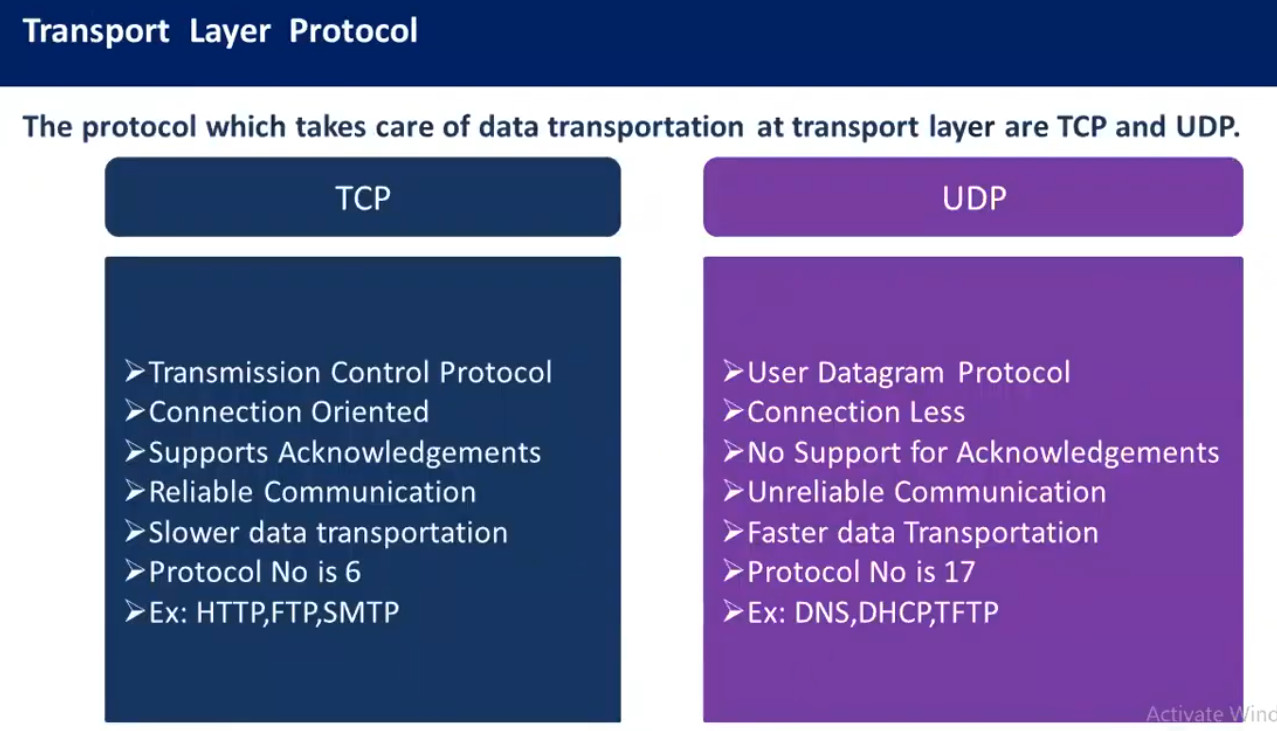
The main difference between TCP and UDP is that TCP is connection-oriented, ensuring reliable data delivery with error checking and retransmission, while UDP prioritizes speed over guaranteed delivery and is connectionless. Here are some other difference between these protocols –
| Parameters | TCP (Transmission Control Protocol) | UDP (User Datagram Protocol) |
| Connection | Connection-oriented protocol | Connectionless protocol |
| Reliability | Reliable delivery of data with error detection and correction | Unreliable delivery of data without error detection or correction |
| Ordering | Guarantees in-order delivery of data | No guarantee of in-order delivery of data |
| Congestion | Includes congestion control mechanisms | No built-in congestion control mechanisms |
| Packet Structure | Contains header and payload information | Contains minimal header information |
| Use Cases | Suitable for applications requiring data integrity and accuracy | Suitable for applications that prioritize speed and efficiency |
What is TCP?
TCP, short for Transmission Control Protocol, is a connection-oriented protocol that ensures reliable and ordered delivery of data packets between devices. It provides error detection, flow control, and congestion control mechanisms to guarantee the successful transmission of data.
TCP establishes a connection between a sender and a receiver before transferring data, ensuring that packets arrive in the correct order and without errors. It retransmits lost or corrupted packets and acknowledges the receipt of data, making it highly reliable.
How TCP Works?
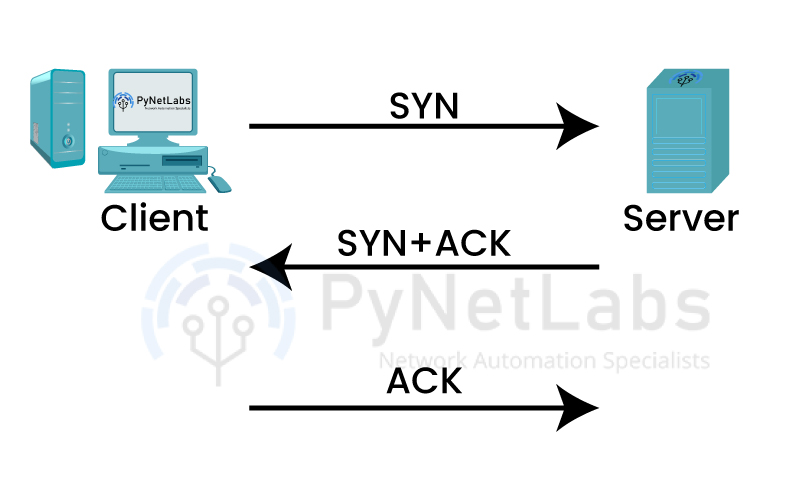
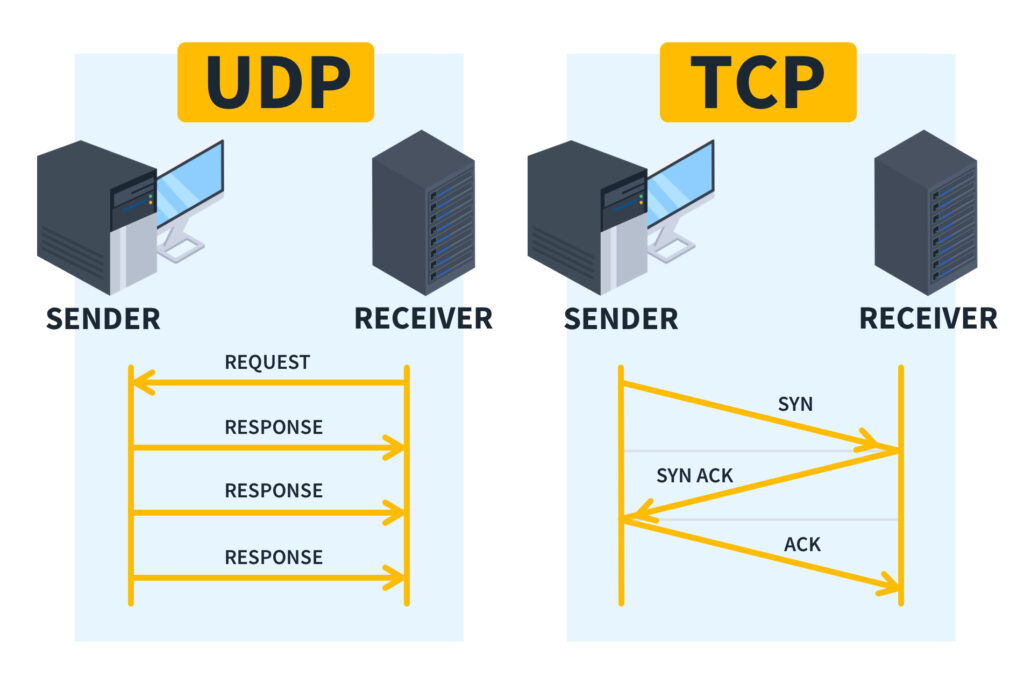
TCP uses a 3-step process which is known as TCP Handshake:
- SYN (Synchronize): Sender sends a SYN Request to start a connection.
- SYN-ACK (Synchronize-Acknowledge): Receiver sends the SYN-ACK as acknowledgement.
- ACK (Acknowledge): The sender confirms, and the connection is established.
Once the connection is active, TCP ensures that all data packets are delivered in order and without errors. If a packet is lost, TCP retransmits it.
Features of TCP
Here are some features of TCP –
- TCP establishes a reliable connection between the sender and receiver before data exchange.
- TCP detects and corrects errors in transmitted data using checksums and retransmission.
- TCP regulates the flow of data to prevent overwhelming the receiver or congesting the network.
- TCP assigns sequence numbers to packets for proper ordering.
- TCP uses acknowledgments to verify successful receipt of data.
Advantages of TCP
- Reliable data delivery
- Error detection and correction
- Ordered data delivery
- Flow control
- Congestion control
- Connection-oriented communication
- Compatibility
- Versatility
- Error recovery
- Widely adopted
Disadvantages of TCP
- More Overhead
- Limited scalability
- TCP is a more complex protocol compared to UDP
- Inefficient for low-bandwidth networks
Where TCP is used?
TCP (Transmission Control Protocol) is used in various applications and scenarios where reliable and ordered data transmission is essential. Here are some common use cases for TCP:
- Web browsing: TCP is used to establish a connection between web browsers and servers.
- File transfer: TCP is employed in protocols like FTP (File Transfer Protocol) and SFTP (Secure File Transfer Protocol).
- Remote access: TCP is utilized in protocols like SSH (Secure Shell) and Telnet to establish secure and reliable remote connections.
- VPN (Virtual Private Network): TCP is often used in VPN implementations to provide secure and reliable communication.
- IoT (Internet of Things) applications: TCP is used in various IoT applications where reliable communication and data delivery are crucial.
What is UDP?
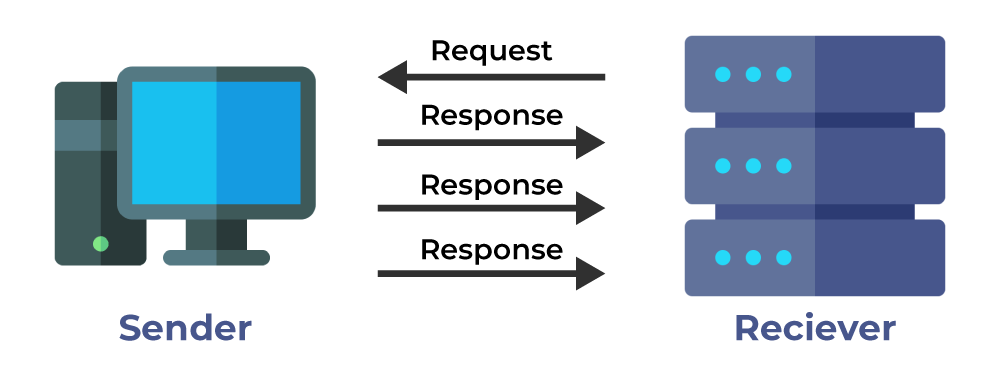
User Datagram Protocol is a transport layer protocol used to transmit data. UDP, unlike TCP, has less overhead for establishing, maintaining, or terminating a connection; hence, it is faster than TCP. In UDP, the data is continuously sent to the recipient irrespective of whether it was received or not.
UDP can be considered a lightweight protocol because of its lesser responsibilities while delivering data. It is unreliable because there is no acknowledgment after receiving the data successfully, which means the sender won’t know if the data was lost during communication or received by the recipient.
How UDP Works?
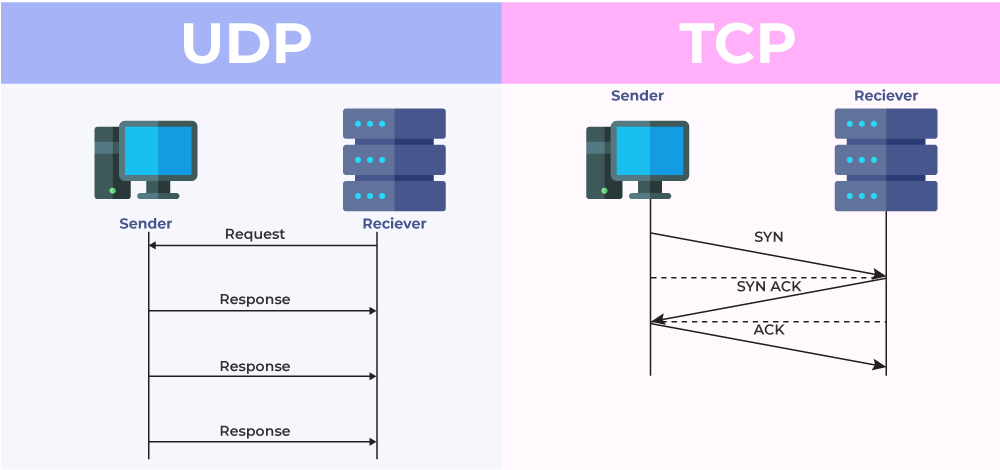
Unlike TCP, UDP does not establish a connection before sending data. It just send packets known as Datagrams. It doesn’t ensure that the data arrives in order or without errors.
Features of UDP
Some of the features of UDP are –
- UDP is a connectionless protocol, meaning it does not establish a dedicated connection before transmitting data.
- UDP has minimal header overhead compared to TCP, making it more lightweight.
- UDP prioritizes speed over reliability, making it suitable for real-time applications that require quick data delivery.
- UDP supports broadcast and multicast communication, allowing efficient data distribution to multiple recipients.
Advantages of UDP
- Low overhead
- High-speed transmission
- UDP has a very simple design
- Reduced network congestion
- Suitable for loss-tolerant applications
Disadvantages of UDP
Here are a few disadvantages of using UDP (User Datagram Protocol):
- UDP does not provide built-in mechanisms for reliable data delivery, error correction, or retransmission.
- It does not ensure the ordered delivery of packets.
- UDP does not perform congestion control.
- Vulnerability to packet loss.
- Inefficient for large data transfers.
- Unsuitable for applications requiring guaranteed delivery.
Where UDP is used?
- UDP is widely used in real-time applications, such as video streaming, live broadcasting, online gaming, and voice over IP (VoIP).
- UDP is the primary protocol used for DNS resolution.
- UDP is often used in IoT applications for transmitting data from connected devices to servers or gateways.
- UDP is the underlying protocol for TFTP, a simple file transfer protocol used for bootstrapping network devices or transferring configuration files.
- UDP is used in DHCP for dynamic IP address assignment.
Difference between TCP and UDP
Now, let’s understand some key difference between TCP and UDP Protocols –
1. Connection
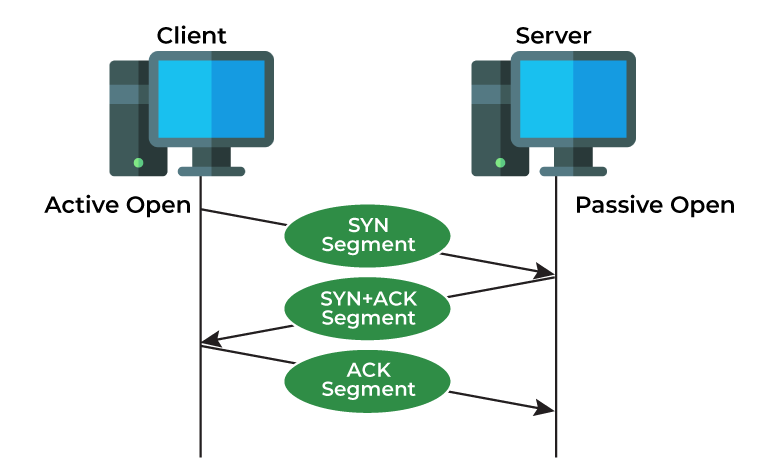
TCP is called a connection-oriented protocol because it requires a logical connection to be established between the two devices to exchange the data. This connection is built by doing a three-way handshake.
This process can be understood with the example of a telephone call where both the users have to get connected first over a session before they can exchange the messages or ideas. On the other hand, we have UDP, which is connection-less as it doesn’t go through any process and can directly send the data to the recipient.
2. Reliability
TCP is a reliable protocol as it provides the reliability of the delivery of packets to the receiver as a connection is built before data transmission. On the other hand, with UDP, we don’t get any surety whether the data was delivered or not; hence, we call it unreliable.
3. Ordering of Messages
TCP guarantees data delivery in the same sequence as the sender sent it. If the segments are received in the wrong order, TCP reorders them. In UDP, there is no such guarantee of the order of segments when they reach the destination.
4. Weight
TCP is considered a heavy-weight protocol because of all the responsibilities it performs. The connection establishment requires the exchange of 3 packets before any data can be exchanged. TCP also handles reliability and congestion and is a heavy-weight protocol with a header size of 20 bytes.
UDP is lightweight as there are no such needs for connection establishment. UDP doesn’t handle the ordering, reliability, etc., while data delivery; hence it ends up being a lightweight protocol with a header size of 8 bytes.
5. Speed
The speed of TCP is slower than the UDP as in UDP; there’s no error recovery mechanism. It is a best-effort protocol which simply means that it will not guarantee the delivery of data.
6. Flow-control
TCP works with flow control, ensuring that many packets are not transmitted over the connection to the receiver, whereas the UDP doesn’t follow a flow control mechanism.
These are the main difference between TCP and UDP, explained in detail.
Similarities between TCP and UDP
TCP and UDP are different but share key features that make them vital for network communication. Here are their similarities:
- Transport Layer Protocols: Both TCP and UDP function at the transport layer of the OSI model. They handle communication between devices over a network, ensuring data is transferred from one device to another, either reliably (TCP) or quickly (UDP).
- Use IP for Packet Routing: Both protocols rely on the Internet Protocol (IP) to route packets across the network. When combined with IP, TCP forms TCP/IP and UDP forms UDP/IP, where IP handles packet delivery and TCP or UDP defines how data is sent.
- Support Multiplexing: TCP and UDP both support multiplexing, which lets multiple applications share a single network connection. They use port numbers to direct data to the right application.
- Send Data in Packets: Both protocols break data into smaller packets for transmission. These packets are reassembled at the destination. TCP uses sequencing to ensure correct order, while UDP does not.
- Operate on the Same Network: TCP and UDP can both function on the same physical network. The choice between them depends on the specific needs of the application (reliability for TCP, speed for UDP).
- Impact of Network Congestion: While TCP manages congestion through flow control, both protocols can face delays, packet loss, or retransmissions (for TCP) when the network is congested.
When to use TCP vs UDP?
- You should choose TCP, when you feel reliability, data accuracy, and order is crucial. It is mainly used for file transfers, web browsing, and emails because any missing or incorrect data can cause significant problems.
- Choose UDP when speed and low latency are more important than reliability. So, it is mainly used in video conferencing, live streaming, and online gaming because in these cases, data loss won’t have any major impact on the users.
Frequently Asked Questions
Q1. What is the difference between TCP and UDP?
TCP ensures reliable, ordered data delivery by establishing a connection, performing error correction, and retransmitting lost packets. UDP, on the other hand, is a connectionless protocol that prioritizes speed and low overhead but does not guarantee reliable delivery or perform error correction.
Q2. What is TCP IP and UDP protocol?
TCP/IP (Transmission Control Protocol/Internet Protocol) is a suite of communication protocols used for transmitting data over networks. TCP is a reliable, connection-oriented protocol that ensures ordered and error-free data delivery, while UDP is a connectionless protocol that offers faster, lightweight communication but does not provide reliability guarantees.
Q3. Why is TCP and UDP used?
TCP is used for applications that require reliable and ordered data delivery, such as web browsing and file transfer, while UDP is used for real-time applications that prioritize speed, such as video streaming and online gaming.
Q4. Is TCP or UDP used more?
TCP is generally used more than UDP due to its reliability and error correction mechanisms, making it suitable for a wide range of applications. However, UDP is favoured in real-time applications where speed is crucial and minor data loss is acceptable, such as video streaming and online gaming.
What is TCP?
TCP is a transport layer connection-oriented protocol. It provides a reliable connection and protected data transmission between the connected machines over a network. It first establishes a secure link and then sends the data.
TCP sends the data from one device to the other in the form of data blocks. It is slow in data transmission but has more functionalities such as flow control, error control, and congestion control in the system.
The TCP header is of 2060 bytes and therefore, it contains several pieces of information to improve the reliability. But, the overhead is raised. Because of its reliability, protocols like HTTP, FTP, etc., use TCP for secured data transmission over the network.
What is UDP?
UDP is a transport layer, connectionless protocol. It provides quick transmission of data between the connected machines over a network. There is no overhead of creating, maintaining, and terminating a connection in UDP.
It is mainly used to transmit real-time data where we cannot afford any transmission delays. UDP sends the data from one device to the other in the form of continuous data streams.
The UDP header is of fixed size, i.e., 8 bytes. It is unreliable but faster in speed. Due to its transmission speed, protocols like DNS, DHCP, RIP, etc., use UDP for proper data transmission over the network.
Differences between TCP and UDP
The following table highlights the major differences between TCP and UDP.
| Key | TCP | UDP |
|---|---|---|
| Definition | It is a communications protocol, using which the data is transmitted between systems over the network. In this, the data is transmitted in the form of packets. It includes error-checking, guarantees the delivery and preserves the order of the data packets. | It is same as the TCP protocol except this doesnt guarantee the error-checking and data recovery. If you use this protocol, the data will be sent continuously, irrespective of the issues in the receiving end. |
| Design | TCP is a connection-oriented protocol. | UDP is a connectionless protocol. |
| Reliability | TCP is more reliable as it provides error checking support and also guarantees delivery of data to the destination router. | UDP, on the other hand, provides only basic error checking support using checksum. So, the delivery of data to the destination cannot be guaranteed in UDP as in case of TCP. |
| Data transmission | In TCP, the data is transmitted in a particular sequence which means that packets arrive in-order at the receiver. | There is no sequencing of data in UDP in order to implement ordering it has to be managed by the application layer. |
| Performance | TCP is slower and less efficient in performance as compared to UDP. Also TCP is heavy-weight as compared to UDP. | UDP is faster and more efficient than TCP. |
| Retransmission | Retransmission of data packets is possible in TCP in case packet get lost or need to resend. | Retransmission of packets is not possible in UDP. |
| Sequencing | The Transmission Control Protocol has a function that allows data to be sequenced (TCP). This implies that packets arrive at the recipient in the sequence they were sent. | In UDP, there is no data sequencing. The application layer must control the order if it is necessary. |
| Header size | TCP uses a variable-length (20-60) bytes header. | UDP has a fixed-length header of 8 bytes. |
| Handshake | Handshakes such as SYN, ACK, and SYNACK are used. | It’s a connectionless protocol, which means it doesn’t require a handshake. |
| Broadcasting | Broadcasting is not supported by TCP. | Broadcasting is supported by UDP. |
| Examples | HTTP, HTTPs, FTP, SMTP, and Telnet use TCP. | DNS, DHCP, TFTP, SNMP, RIP, and VoIP use UDP. |
TCP – Transmission Control Protocol and
UDP – User Datagram Protocol.
Both TCP and UDP are built on top of the Internet Protocol (IP), and both send bits of data, known as packets, to and from IP addresses. While both protocols do the same job, they go about it in very different ways. TCP is more concerned about accuracy. It allows devices to send and receive an ordered and error-checked stream of packets. UDP is more concerned with speed. It streams information faster by eliminating the error-checking.
Vinton G. Cerf is known as the “Father of the Internet“. He is the co-designer of the TCP/IP protocols and the architecture of the Internet. The US President, Bill Clinton presented the U.S. National Medal of Technology to Cerf and his colleague, Robert E. Kahn, for founding and developing the wonderful creation of the Internet in December 1997.

he contribution of Cerf and his colleagues have been acknowledged and applauded all over the world. Today, we cannot imagine our lives without the Internet.
Vint Cerf has been awarded many honorary degrees and prizes that include the Turing Award, the Presidential Medal of Freedom, the Marconi Prize and membership in the National Academy of Engineering and many more.