
Ledger,Group,Voucher Entery
What is a Ledger?
A Tally Ledger is one of the most important elements in Tally Prime.
It represents an individual account where all the transactions related to a specific item, person, expense, income, asset, or liability are recorded.
Definition:
A Ledger in Tally is a record of all financial transactions related to a particular account.
Every transaction you enter in Tally must be linked to two or more ledgers (as per the double-entry system).
Examples of Ledgers:
- Cash Account
- Bank Account (SBI, HDFC, etc.)
- Sales Account
- Purchase Account
- Capital Account
- Rent Account
- Electricity Expense Account
- Debtors (Customers) – e.g., Rahul Traders
- Creditors (Suppliers) – e.g., ABC Suppliers
Why Ledgers Are Important in Tally?
- Every voucher entry uses ledgers.
- Helps keep accounts organized under proper groups.
- Generates reports like Balance Sheet, P&L, Stock Summary, etc.
- Ensures accurate financial analysis.
Each Ledger Has Two Important Things:
1. Name of the Ledger
(E.g., Cash, Sales, Purchase, Rent, Electricity, etc.)
2. Under (Group)
This shows under which category the ledger belongs, such as:
- Cash-in-hand
- Bank Accounts
- Sales Accounts
- Indirect Expenses
- Sundry Debtors
- Sundry Creditors
Simple Example:
If you create a Rent Account ledger:
- Name: Rent
- Under: Indirect Expenses
Whenever you pay rent, Tally will use this ledger to record the expense.
In Short:
The Tally Ledger is the basic building block of accounting in Tally.
Without ledgers, you cannot record any transactions.
What is a Voucher in Tally Prime?
A Voucher in Tally is a document used to record a transaction.
It is the screen where you enter debit and credit information.
Every financial activity in a business — buying, selling, paying, receiving — is recorded using vouchers.
Why Vouchers Are Important?
- They record every transaction of the business
- They help maintain accurate accounts
- They follow the double-entry system (Debit–Credit)
- They help generate reports like Trial Balance, Profit & Loss, and Balance Sheet
Types of Vouchers in Tally Prime?
Tally provides predefined voucher types for different kinds of transactions.
These vouchers are grouped into Accounting, Inventory, and Order vouchers.
A. Accounting Vouchers
These record financial transactions.
1. Contra Voucher (F4)
Used for cash ↔ bank transfers.
Examples:
- Cash deposited in bank
- Cash withdrawn from bank
2. Payment Voucher (F5)
Used when the business pays money.
Examples:
- Paying salary
- Paying rent
- Paying supplier
3. Receipt Voucher (F6)
Used when the business receives money.
Examples:
- Customer payment
- Interest received
4. Journal Voucher (F7)
Used for adjustment entries (not involving cash or bank).
Examples:
- Depreciation
- Outstanding salary
- Prepaid expenses
5. Sales Voucher (F8)
Used when the business sells goods or services.
Examples:
Selling products to customers
6. Purchase Voucher (F9)
Used when the business buys goods or services.
Examples:
- Purchasing raw materials
- Buying products for resale
7. Debit Note
Issued when goods are returned to the supplier or overcharged.
(Also called Purchase Return)
8. Credit Note
Issued when customer returns goods or is overcharged.
(Also called Sales Return)
B. Inventory Vouchers
Used for stock or product movement.
1. Delivery Note
When goods are sent out to customers.
2. Receipt Note
When goods are received from suppliers.
3. Stock Journal
Used for stock adjustment or stock transfer.
4. Physical Stock
Used for stock verification.
C. Order Vouchers
1. Sales Order
When a customer places an order.
2. Purchase Order
When the business orders goods from a supplier.
Example to Understand Voucher Entry
Transaction: Paid ₹5,000 Rent in Cash
- Voucher Type: Payment Voucher
- Debit: Rent A/c ₹5,000
- Credit: Cash A/c ₹5,000
This is entered in the Payment Voucher screen.
In Short:
- Voucher = Transaction Entry
- Every transaction must be recorded through a voucher
- Different vouchers are used for different activities
What is a Group in Tally Prime?
A Group in Tally is a category used to classify ledger accounts.
Tally uses groups to identify:
- Whether a ledger is an asset, liability, income, or expense
- Where it will appear in the Balance Sheet or Profit & Loss A/c
- How reports should be generated
Every ledger you create must belong to a group.
This is done using the “Under” option while creating a ledger.
Why Groups Are Important?
They help Tally organize accounts properly.
They allow Tally to automatically prepare financial statements.
They ensure accuracy in accounting.
They help in summarizing financial information.
Without groups, ledgers cannot be classified correctly.
Types of Groups in Tally
Tally has 28 predefined groups divided into two main categories:
A. Primary Groups (Balance Sheet Items)
These groups relate to Assets and Liabilities.
1. Capital Account
- Owner’s capital
- Drawings
- Reserves & Surplus
2. Loans (Liability)
- Bank Loan
- Debentures
- Secured & Unsecured Loans
3. Current Liabilities
- Sundry Creditors
- Outstanding Expenses
- Duties & Taxes (GST, VAT)
- Provisions
4. Current Assets
- Cash-in-Hand
- Bank Accounts
- Sundry Debtors
- Stock-in-Hand
- Deposits
- Advance Payments
5. Fixed Assets
- Land & Building
- Furniture
- Machinery
- Vehicles
6. Investments
- Shares
- Mutual Funds
- Bonds
7. Suspense Account
Used temporarily when an account is not identified.
8. Misc. Expenses
Deferred expenses or preliminary expenses.
B. Revenue Groups (Profit & Loss Items)
These groups relate to Incomes and Expenses.
9. Direct Income
- Sales-related income
- Export incentives
10. Indirect Income
- Commission Received
- Interest Received
- Discount Received
11. Direct Expenses
- Wages
- Freight Inwards
- Power & Fuel
- Carriage Inwards
12. Indirect Expenses
- Rent
- Salary
- Advertising
- Electricity
- Telephone
All 28 Groups in Tally (Complete List)?
Primary Groups
Capital Account
Reserves & Surplus
Loans (Liability)
Current Liabilities
Duties & Taxes
Provisions
Bank OD A/c
Secured Loans
Unsecured Loans
Current Assets
Bank Accounts
Cash-in-Hand
Sundry Debtors
Fixed Assets
Investments
Loans & Advances (Asset)
Stock-in-Hand
Deposits (Asset)
Branch/Divisions
Suspense Account
Misc. Expenses (Asset)
Revenue Groups
Sales Accounts
Purchase Accounts
Direct Income
Indirect Income
Direct Expenses
Indirect Expenses
Closing Stock
Simple Example to Understand Groups
Example 1: Creating a Rent Ledger
- Ledger Name: Rent
- Under: Indirect Expenses
Because rent is an expense, it falls under Indirect Expenses.
Example 2: Creating a Customer Ledger
- Ledger Name: Rahul Traders
- Under: Sundry Debtors
Because customers who buy on credit are debtors.
Example 3: Creating a Bank Account Ledger
- Ledger Name: HDFC Bank
- Under: Bank Accounts
Because it is part of your current assets.
In Short
- Group = Category
- Ledger = Account
- Voucher = Transaction
Groups help Tally determine where a ledger appears in the accounting system.
Types of Businesses in Accounting
1. Service Organisation / Service Company
A business that provides services instead of physical products.
Examples:
- Hospitals
- Banks
- Salons
- Hotels
- Transport services
- IT services
Features:
- No inventory
- Revenue from services
- Labour-intensive
Short Answer
Types of companies:
- Service Organisation – provides services
- Trading Company – buys and sells goods
- Manufacturing Company – produces goods
2. Trading Company
A business that buys goods and sells them without changing their form.
Examples:
- Supermarkets
- Clothing stores
- Electronics shops
- Wholesalers
- Retailers
Features:
- Maintains inventory (goods for resale)
- Buys at one price, sells at a higher price
- Profit = Selling Price – Cost Price
3. Manufacturing Company
A business that converts raw materials into finished products.
Examples:
- Furniture factories
- Car manufacturers
- Food processing units
- Textile mills
- Toy factories
Features:
- Uses raw materials, labor, and machines
- Produces finished goods
Has 3 types of inventory:
- Raw materials
- Work-in-progress (WIP)
- Finished goods
Voucher Entery In Tally

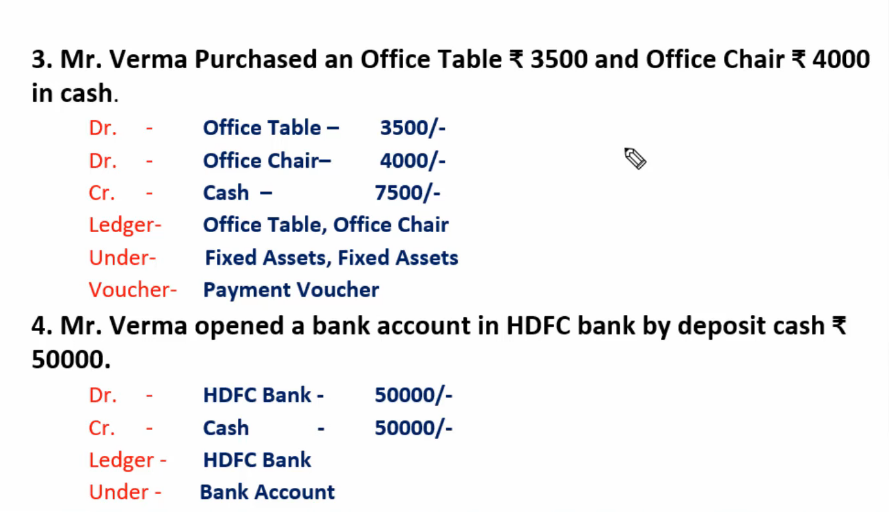
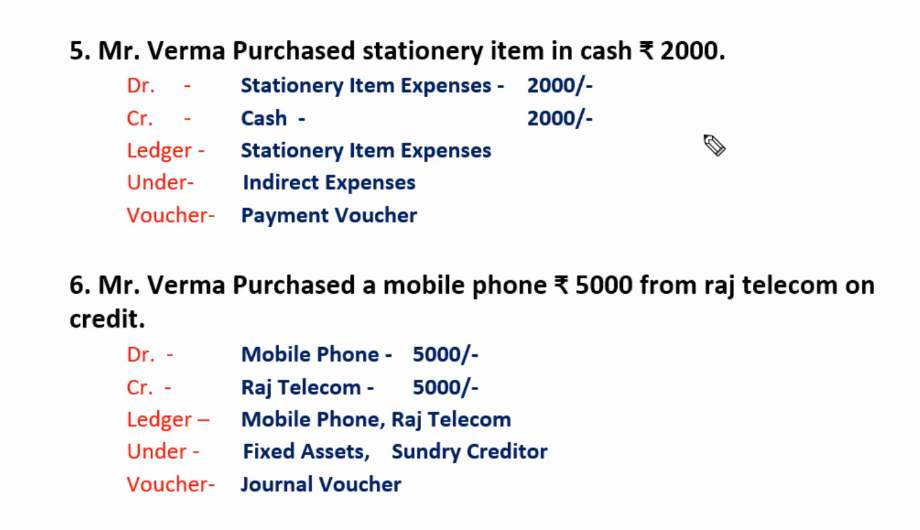
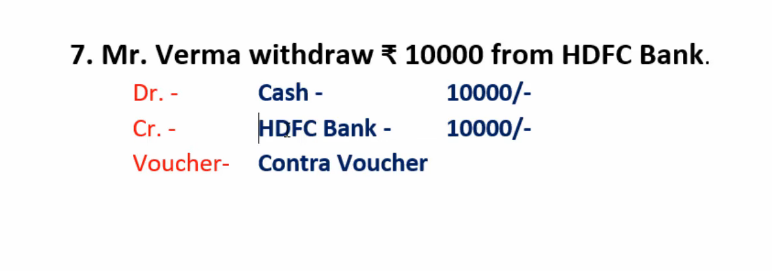
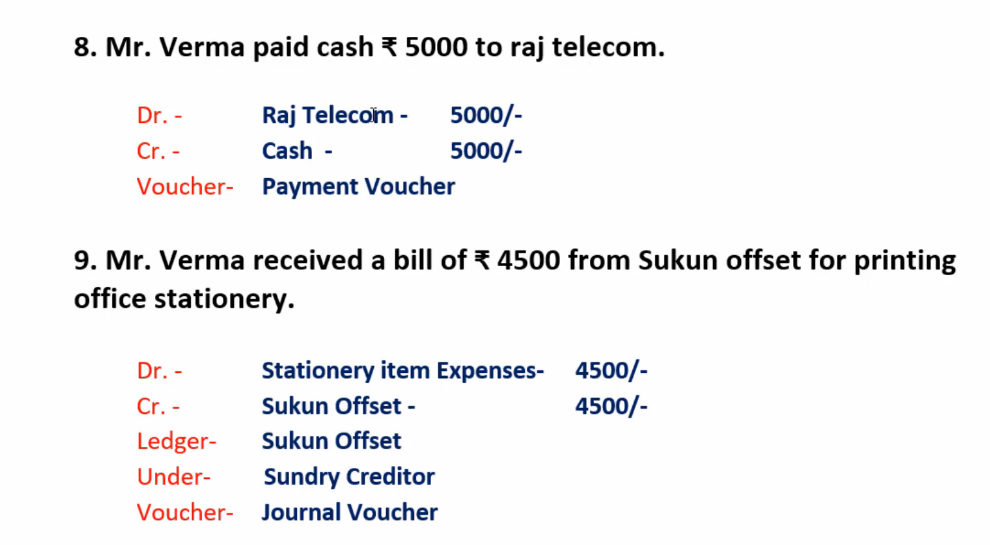
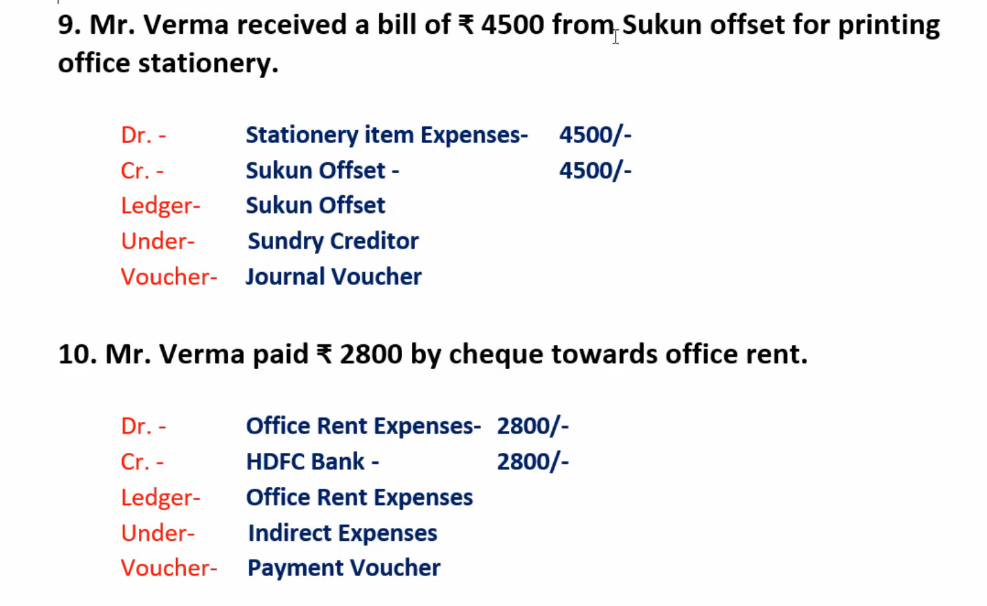
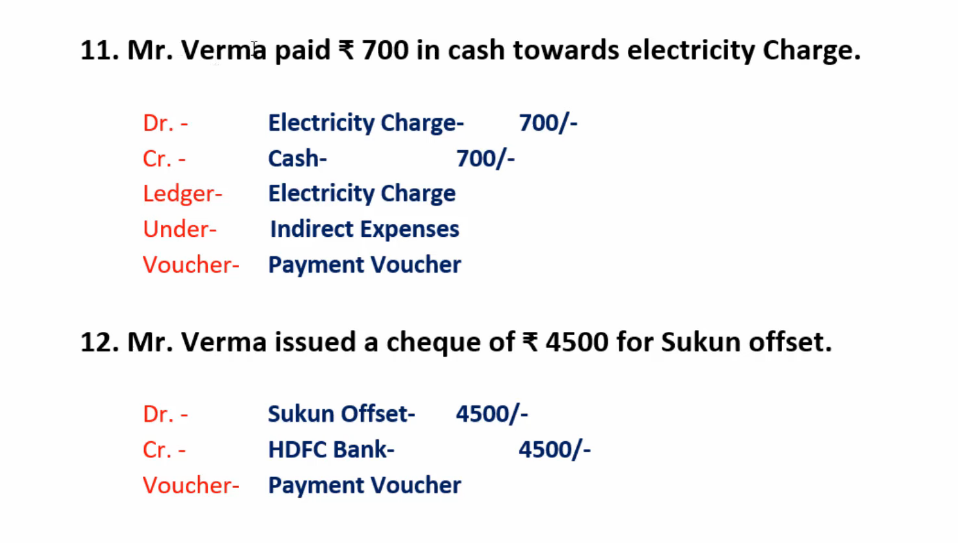
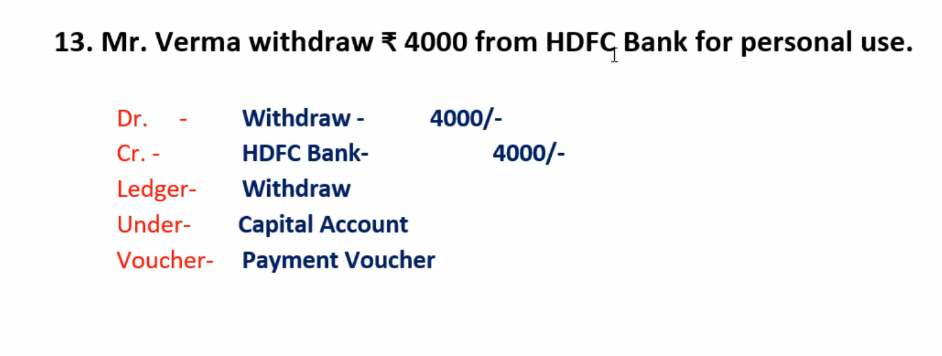
Date:- 1-4-2020
1. Arpit Kumar Verma started a business solutions by bringing in cash of Rs.300000.?
Credit – Arpit Kumar Verma
Debit – Cash
Ledger – Arpit Kumar Verma
Under – Capital account
Voucher – Recipet
Account – Arpit kumar verma,Cash
Golden Rule – (Giver – Arpit kumar verma Credit) (Whats Goes – Cash Debit)
Date:- 2-4-2020
2. Mr. Verma paid Rs.22500 in cash to purchase a computer.The computer does not have any disposal value at the end
Credit – Cash
Debit – Computer
Ledger – Computer
Under – Fixed Assets
Voucher – Payment
Account – Computer,Cash
Golden Rule – (Whats Come – Computer Debit) (Whats Goes – Cash Credit)
Date:- 3-4-2020
3. Mr. Verma opened a bank account in HDFC Bank and deposit cash of Rs.100000
Credit – Cash
Debit – HDFC Bank
Ledger – HDFC Bank,Cash
Under – Bank Account
Voucher – Contra
Account – Personal,Real
Golden Rule – (Whats Goes – Cash Debit) (Giver – Cash Credit)
Date:- 4-4-2020
4. Mr. Verma rented an office apace for Rs.2500 per month on April 01, 2020 He paid the security deposit of Rs. 25000 by cheque.
Credit – HDFC Bank
Debit – Security Deposit
Ledger – Security Deposit,HDFC Bank
Under – Deposits Asset
Voucher – Payment
Account – Nominal,Personal
Golden Rule – (Expence – Security Deposit Debit) (Giver – HDFC bank Credit)
Date:- 5-4-2020
5. Mr. Verma issued cheque and purchased the following fixed assets.
1. Cell Phone Rs.6000 (useful life-5 years)
2. Furniture Rs.20000 (useful life-8 years)
3. AIR Conditioner Rs.20000 (useful life-6 years)
4. Electrical fittings Rs.15000 (useful life-10 years)
The above assets do not have any disposal value at the end
of their useful life.
Credit – HDFC Bank
Debit – Cell Phone,Furniture,AIR Conditioner,Electrical fittings
Ledger – Cell Phone,Furniture,AIR Conditioner,Electrical fittings,HDFC Bank
Under – Indirect Expenses
Voucher – Payment
Account – Real,Personal
Golden Rule – (Expenses – Security Deposit) (Giver – HDFC Bank – Credit)
Date:- 6-4-2020
6. Mr. Verma obtained a mobile phone subscription from Planet telecommunications, by paying a deposit of Rs.3000 in cash.
Credit – Cash
Debit – Security Deposit
Ledger – Security Deposit Phone,Cash
Under – Deposits Asset
Voucher – Payment
Account – Real,Real
Golden Rule – (Whats Come – Security Deposit) (Whats Goes – Cash)
Date:- 20-4-2020
7. Mr. Verma purchased stationary consumables worth Rs.12500 from Global House, on credit.
Credit – Global House
Debit – Stationary
Ledger – Stationary Expenses,Global House
Under – Indirect Expenses,Sundery Creditors
Voucher – Journal
Account – Personal,Nominal
Golden Rule – ( Expenses – Stationary) (Giver – Global House Credit)
8.Date:- 21-4-2020
8. Mr. Verma signed a contract with Silver Services to provide consultancy services at an agreed price of Rs.75000. He received an advance of Rs.25000 by cheque.
Credit – Advance Consultancy
Debit – HDFC Bank
Ledger – Advance Consultancy
Under – Create Secondery Group (Advance From Customar)
Voucher – Recipt
Account – Personal,Real
Golden Rule – ( Reciver – HDFC Bank Debit) (Whats Come – Advance Consultancy Credit)
Date:- 23-4-2020
9. Mr. Verma deposit Rs.50000 cash in HDFC Bank.
Credit – Cash
Debit – HDFC Bank
Ledger – HDFC Bank,Cash
Under – Bank Account
Voucher – Contra
Account – Personal,Real
Golden Rule – ( Reciver – HDFC Bank Debit) (Whats Goes – Cash Credit)
Date:- 25-4-2020
10. Mr. Verma received an invoice for Rs.6000 from Ink and Paper Publishers for printing office stationary.
Credit – Ink and Paper Publishers
Debit – office stationary
Ledger – Ink and Paper Publishers,Stationary
Under – Sundery Creditor,Indirect Expences
Voucher – Journal
Account – Personal,Nominal Account
Golden Rule – (Giver – Ink and Paper Publishers – Credit) (Expence – Stationary Debit)
Date:- 27-4-2020
11. Mr. Verma withdrew Rs.7500 cash for personal use.
Credit – Cash
Debit – withdrew
Ledger – Cash,Withdrew
Under – Capital Account
Voucher – Payment
Account – Personal,Nominal Account
Golden Rule – ( Giver – Bussines – Credit) ( withdrew – Debit)
Date:- 30-4-2020
Mr. Verma paid Rs.750 in cash towards office maintenance charges.
Credit – Cash
Debit – office maintenance
Ledger – office maintenance,Cash,
Under – Indirect Expences,
Voucher – Payment
Account – Real,Nominal Account
Golden Rule – (What Goes – Cash – Credit) (Expences – office maintenance – Debit)