VPLS Technology
History of VPLS (Virtual Private LAN Service)
History of VPLS (Virtual Private LAN Service)
The development of VPLS (Virtual Private LAN Service) is closely related to the evolution of Ethernet networks and Multiprotocol Label Switching (MPLS). As businesses began expanding across multiple cities and countries, there was a growing need to connect remote LANs as if they were part of a single network. This requirement led to the creation of VPLS.
Early Networking Era (Before VPLS)
In the early days of networking (1980s–1990s), organizations used technologies like leased lines, Frame Relay, and ATM (Asynchronous Transfer Mode) to connect remote sites. These technologies were expensive and complex to manage.
At that time, most networks were based on Layer 3 routing, which meant that each site was a separate network. Extending Layer 2 networks across long distances was difficult, and applications that depended on broadcast traffic or Layer 2 communication faced limitations.
Emergence of MPLS (Late 1990s)
In the late 1990s, MPLS was introduced as a high-performance forwarding technology. MPLS allowed service providers to route traffic efficiently using labels instead of traditional IP lookups.
Initially, MPLS was mainly used for Layer 3 VPNs (L3VPN), which solved many routing problems but did not support Layer 2 LAN extension. Enterprises still needed a way to extend Ethernet networks across multiple locations.
Birth of VPLS (Early 2000s)
In the early 2000s, VPLS was introduced to address this gap. It was designed to provide Layer 2 VPN services over MPLS networks, enabling customers to connect multiple sites as if they were on the same Ethernet LAN.
Standardization efforts were carried out by organizations like the Internet Engineering Task Force. Key RFCs (Request for Comments) were published, such as:
- RFC 4761 (BGP-based VPLS)
- RFC 4762 (LDP-based VPLS)
These standards defined how VPLS should work, including signaling, MAC learning, and label distribution.
Growth and Adoption (Mid 2000s–2010s)
During this period, VPLS gained popularity among service providers and large enterprises. It became widely used for:
- Connecting branch offices
- Data center interconnection
- Providing Ethernet services to customers
Telecom operators started offering VPLS as a managed service, allowing businesses to extend their LANs without managing complex WAN infrastructure.
However, as networks scaled, VPLS faced challenges such as MAC table growth and full mesh requirements between Provider Edge (PE) routers.
Evolution Beyond VPLS (Modern Era)
To overcome VPLS limitations, newer technologies were developed, such as:
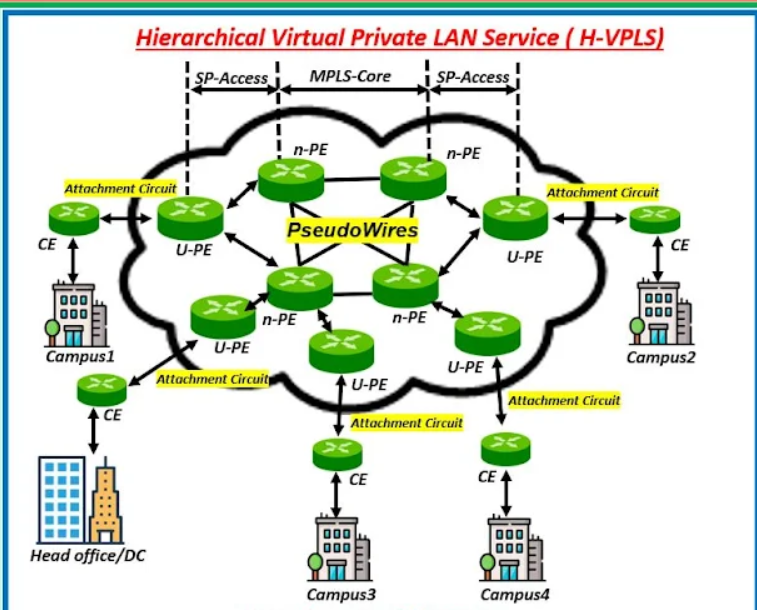
- Hierarchical VPLS (H-VPLS)
- EVPN (Ethernet VPN)
EVPN, in particular, uses BGP for control plane signaling and provides better scalability and flexibility compared to traditional VPLS.
Today, while VPLS is still used in many networks, many service providers are gradually moving toward EVPN-based solutions for modern data center and cloud environments.
Summary
The history of VPLS reflects the evolution of networking from simple point-to-point connections to scalable, virtualized LAN services. Starting from the limitations of early WAN technologies, VPLS emerged as a powerful solution built on MPLS to provide seamless Layer 2 connectivity across geographically distant sites. Over time, it has evolved and paved the way for more advanced technologies like EVPN.
VPLS (Virtual Private LAN Service)
What is VPLS (Virtual Private LAN Service)
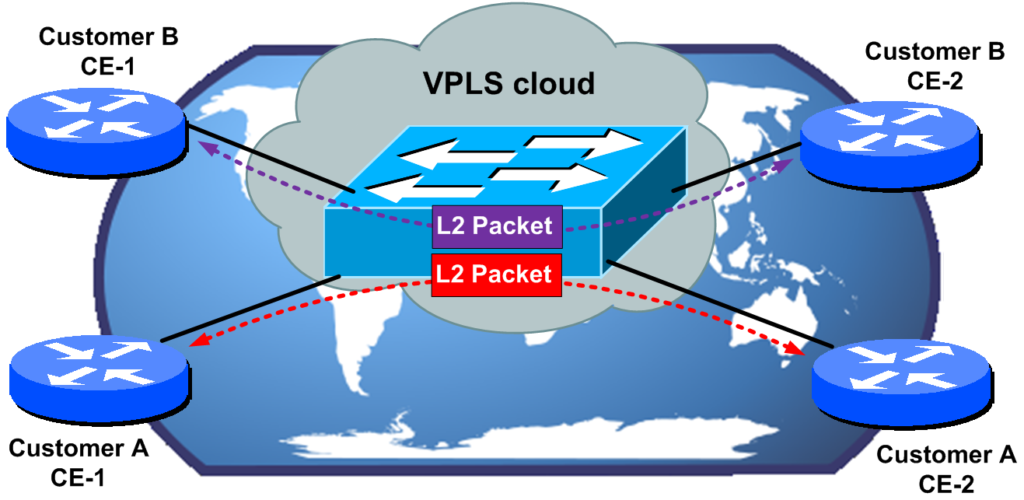
VPLS (Virtual Private LAN Service) is a Layer 2 VPN technology built on top of Multiprotocol Label Switching (MPLS) that allows multiple geographically separated sites to communicate as if they are part of the same Local Area Network (LAN). In simple terms, VPLS creates a single virtual Ethernet network across a service provider’s MPLS backbone, making distant offices behave like they are connected to the same switch.
How VPLS Works (Detailed Explanation)
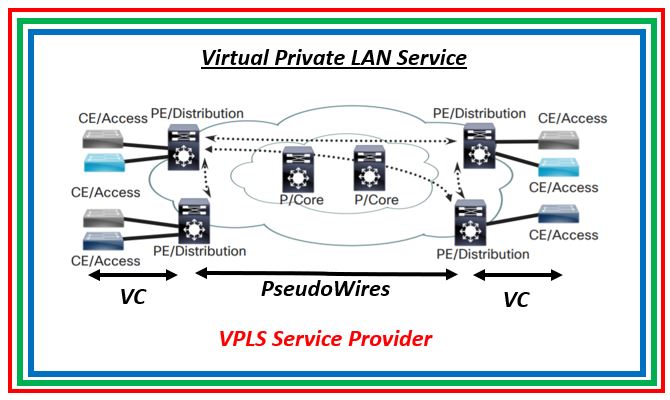
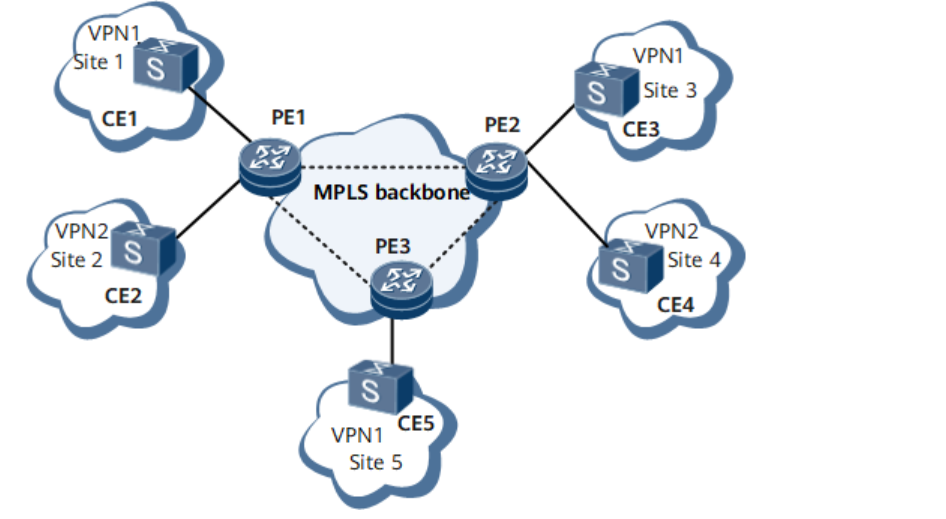
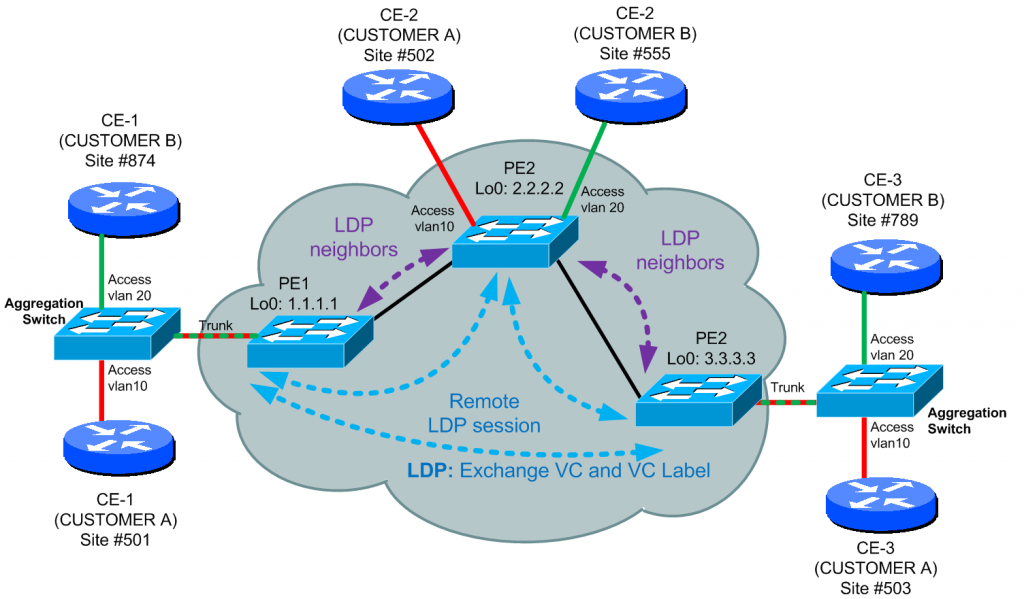
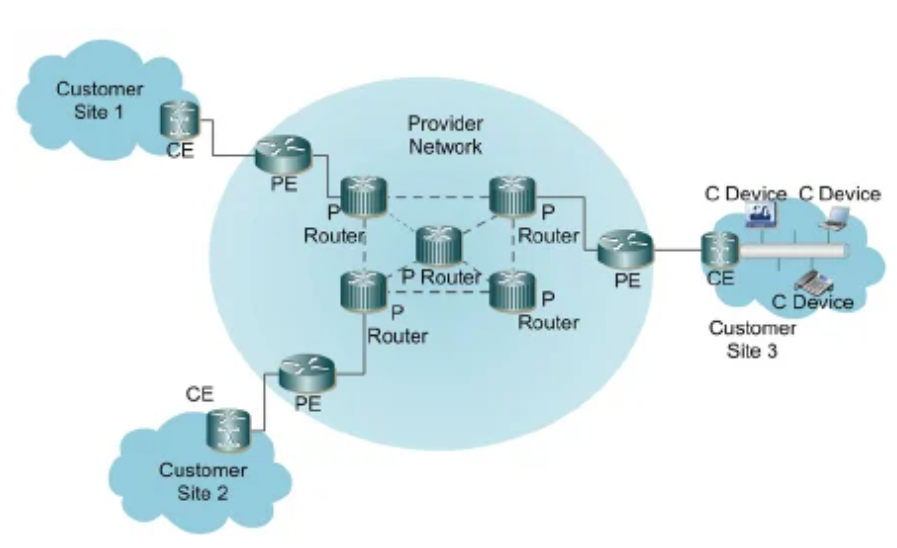
VPLS operates over an MPLS network where service providers use Provider Edge (PE) routers to interconnect customer sites.
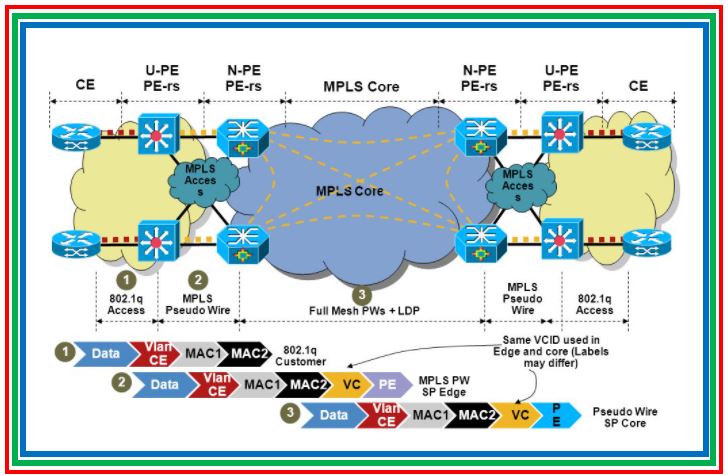
When a customer connects their LAN to a provider’s PE router, the PE device learns MAC addresses from that site, just like a switch. These MAC addresses are then shared with other PE routers participating in the same VPLS instance. When data is sent from one site to another, the ingress PE router attaches an MPLS label and forwards the traffic across the MPLS backbone. The egress PE router removes the label and delivers the frame to the destination site.
This process allows all connected sites to communicate using Layer 2 Ethernet frames, making it appear as if they are on the same physical switch even though they are miles apart.
Key Characteristics of VPLS
VPLS provides full mesh connectivity, meaning every site can directly communicate with every other site without needing separate tunnels. It supports Ethernet-based communication, including broadcast, multicast, and unknown unicast traffic, just like a traditional LAN. Since it operates at Layer 2, it is protocol-independent and can carry different types of network protocols.
Another important feature is MAC address learning and forwarding. Just like a switch, VPLS dynamically learns which MAC addresses belong to which sites and forwards traffic accordingly. This makes it flexible and easy to deploy in enterprise environments.
Example of VPLS (Real-World Scenario)
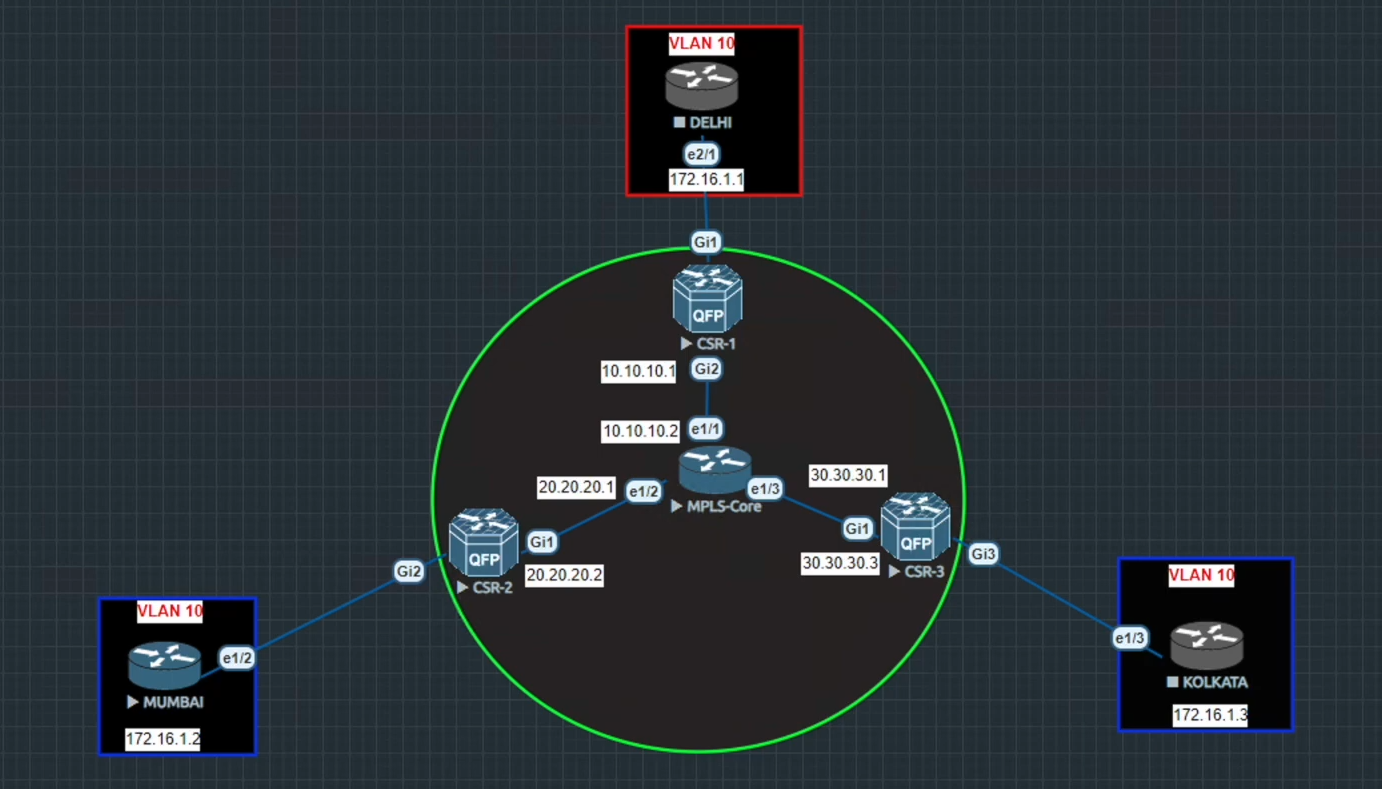
Consider a company with three branch offices located in Kolkata, Delhi, and Mumbai. Each office has its own LAN with computers, printers, and servers.
Without VPLS, these offices would need separate Layer 3 VPN connections, and routing would be required between sites. However, with VPLS, all three locations are connected through the service provider’s MPLS network and appear as a single LAN.
For example, a computer in the Kolkata office can send an Ethernet frame directly to a printer in the Delhi office without any routing configuration. Similarly, broadcast traffic such as ARP requests can be shared across all sites, just like in a local network.
Why VPLS is Needed
VPLS is useful for organizations that want to extend their LAN across multiple locations without dealing with complex routing configurations. It simplifies network design by providing a plug-and-play Layer 2 connectivity model. Businesses can easily add new sites to the network without major changes.
It is especially beneficial for applications that rely on Layer 2 communication, such as legacy systems, VLAN extension, or clustering technologies that require all nodes to be in the same broadcast domain.
Problems Without VPLS
Without VPLS, companies must rely on Layer 3 VPNs or traditional WAN technologies. This introduces additional complexity because routing protocols must be configured and maintained. Broadcast traffic cannot be easily shared, and some applications may not function properly across routed networks.
Additionally, managing multiple point-to-point connections becomes difficult as the number of sites increases, leading to scalability issues.
Summary
VPLS is a powerful technology that extends LAN services over an MPLS network, enabling seamless communication between multiple remote sites. It combines the simplicity of Ethernet LANs with the scalability and performance of MPLS, making it an ideal solution for modern enterprise networks.
MPLS vs VPLS : Detailed Difference
MPLS vs VPLS : Detailed Difference
Both Multiprotocol Label Switching (MPLS) and VPLS (Virtual Private LAN Service) are used in modern networks, but they are not the same thing. MPLS is a technology, while VPLS is a service built on top of MPLS.
Basic Concept Difference
MPLS is a packet-forwarding technology that uses labels to move data quickly across a network. It works mainly at Layer 2.5 (between Layer 2 and Layer 3) and is used by service providers to build fast and scalable networks.
VPLS, on the other hand, is a Layer 2 VPN service that runs over an MPLS network. It allows multiple remote LANs to connect as if they are part of the same Ethernet network.
Key Differences (Table)
| Feature | MPLS | VPLS |
|---|---|---|
| Type | Technology | Service |
| Layer | Layer 2.5 | Layer 2 |
| Purpose | Fast packet forwarding | LAN extension over WAN |
| Function | Uses labels to route traffic | Connects multiple LANs as one |
| Connectivity | Point-to-point or L3 VPN | Any-to-any (full mesh) |
| Awareness | IP-based forwarding | MAC-based forwarding |
| Usage | Backbone networks | Enterprise LAN extension |
Working Difference
In MPLS, routers (called Label Switch Routers) assign labels to packets and forward them based on these labels. This makes routing faster and more efficient compared to traditional IP routing.
In VPLS, the MPLS network is used as a transport medium. VPLS creates a virtual switch across multiple locations. It learns MAC addresses and forwards Ethernet frames, just like a physical switch, allowing all connected sites to communicate at Layer 2.
Example (Real-World Scenario)
Imagine a company with offices in Kolkata, Delhi, and Mumbai:
- If you use MPLS (L3 VPN):
Each office is a separate network. Communication happens through routing (IP-based). You need routing protocols like OSPF or BGP. - If you use VPLS:
All offices behave as if they are in the same LAN. A device in Kolkata can directly communicate with a device in Delhi using MAC addresses, without routing.
When to Use MPLS vs VPLS
Use MPLS (L3 VPN) when:
- You want scalable routing between sites
- You don’t need broadcast traffic
- You prefer Layer 3 control
Use VPLS when:
- You need LAN extension across locations
- Applications require Layer 2 connectivity
- You want plug-and-play network expansion
Advantages Comparison
MPLS Advantages:
- High performance and speed
- Scalable for large networks
- Supports traffic engineering
VPLS Advantages:
- Simple LAN-like connectivity
- No routing complexity
- Supports broadcast and multicast
Limitations Comparison
MPLS Limitations:
- Requires routing configuration
- Not suitable for Layer 2 applications
VPLS Limitations:
- MAC table scalability issues
- Broadcast traffic can increase
- Full mesh requirement between PE routers
Final Summary
- MPLS = Transport Technology (Backbone)
- VPLS = Service using MPLS (LAN extension)
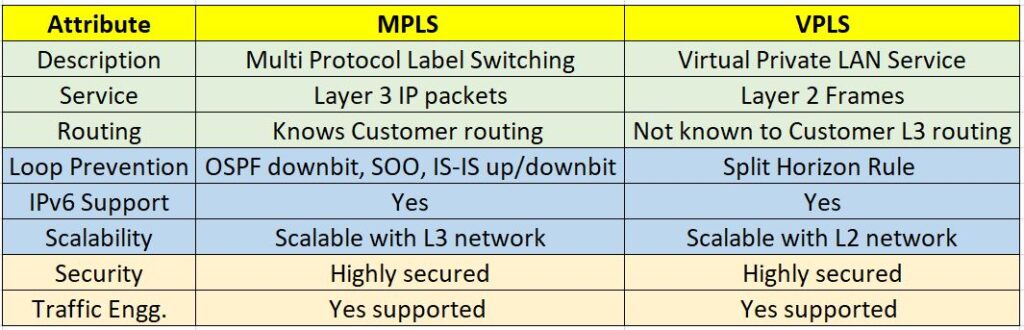
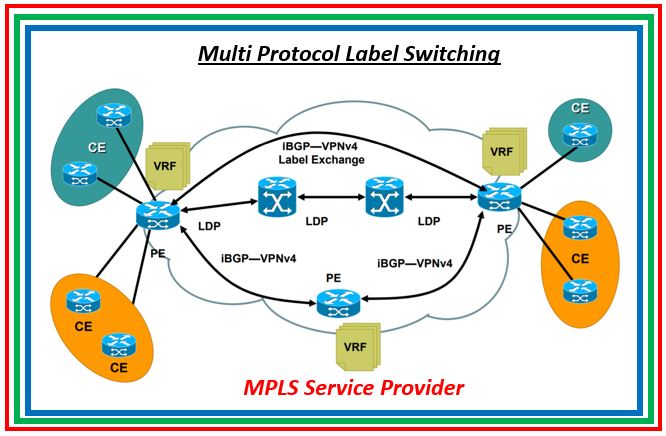
MPLS:MPLS stands for Multi Protocol Label Switching
MPLS which actually using switching ( Label) in the core and routing on the edges. MPLS is always the core of the service provider and the connectivity from one PE router to another PE router will be via MPLS technology.
MPLS technology where you have internal routing protocol for data traffic like OSPF( Open shortest path First ) and IS-IS ( intermediate system to intermediate system ) and the concepts of the label which is handled by the protocol LDP/TDP ( Label distribution protocol or Tag distribution protocol ) and the control plane traffic flows from the indirectly connected MP-iBGP protocols between two PE routers across the globe of the single Service provider.
VPLS:VPLS stands for Virtual Private LAN Service
VPLS (Virtual Private Label Switching) is a type of VPN that connects multiple sites within one bridged domain over a managed IP or MPLS network. To link remote sites, VPLS uses a virtualized Ethernet switch at the provider’s edge. At Layer-2, VPLS works and the provider builds out the network.
The customer however, has the option of doing their own routing. So which means VPLS provider dont know about the L3 routes on the sites and they are generally sends L2 traffic over the Ethernet based underlay networks.